The SUV That Wasn’t
DETROIT, November 3, 2026 — General Motors has reportedly scrapped long-rumoured plans to spin the Chevrolet Corvette into a family of vehicles, including an SUV and a dedicated electric model, after softer EV demand and sustained pushback from the car’s enthusiast base. GM has neither confirmed the programmes existed nor issued a statement that they are cancelled, according to TFLcar, which reported the decision on November 2.
The silence is itself part of the story. The technical reality is that a Corvette SUV was never formally announced, only widely expected, and the loudest signal came not from a press release but from the forums and social feeds where the Vette faithful gather. Their verdict was blunt: a tall, four-door Corvette was a betrayal of the brand’s soul.
Seventy-Three Years of Two Seats
The Corvette has been a two-door, two-seater since 1953, built across eight generations designated C1 through C8. It is the only domestic mass-produced two-seater continuously fielded by a US automaker, having outlasted rivals from American Motors, Ford and Chrysler. The name came from a small, manoeuvrable warship, suggested by Myron Scott, then assistant director of GM’s public relations department.
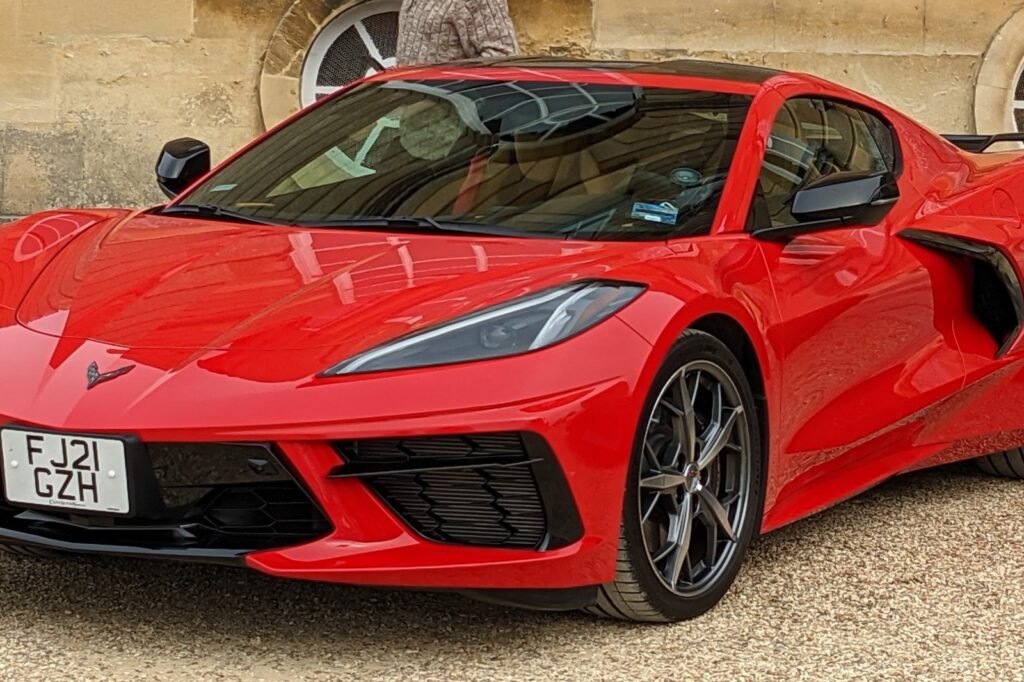
What began as a modest six-cylinder convertible moved upmarket through V8 engines, chassis innovation and, with the C8, a rear-mid-engine layout. Since the C4, introduced in 1983 as an early 1984 model, Corvettes have used GM’s unibody Y-body platform. For seven generations the engine sat in front of the driver; the C8 broke that line in 2019. Through it all the car has been judged on handling and driver engagement rather than utility, which is precisely the quality an SUV cannot carry.
Why the SUV and EV Push Clashed With the Brand
The cautionary example sits across town. Ford stretched the Mustang name over the Mach-E, an electric crossover, and the move became a reference point for what can go wrong when a heritage badge is asked to sell something it was never built to be. For GM, the reported calculation was twofold: battery-electric demand has cooled, and the Corvette community was never sold on the idea.
Enthusiasts had spent years arguing on social media and forums that an SUV or a battery-electric Corvette would dilute the performance-focused DNA. When the reported cancellation landed, the reaction was widespread relief. The C8’s own mid-engine switch had been fiercely debated, but performance data settled that argument. An SUV, by contrast, had no stopwatch to win it.
The Value Play, Not the Exotic
Money sits under the decision as much as sentiment. The 2027 Corvette Stingray starts at $73,795 including destination; the lineup tops out with the ZR1X at $227,695.
Corvette chief engineer Tony Roma has drawn a line on how far the C9 can climb. He told The Drive the next generation must beat the C8 on performance without turning into a prestige-priced exotic, and he has pushed back on the idea that Chevrolet has to chase Lamborghini and Ferrari sticker for sticker. Keeping the gap between entry-level and flagship versions, rather than bridging it with one sky-high price, is the stated aim.
That same logic governs the gearbox debate. Roma would personally love a manual in a mid-engine Corvette, but a clutch pedal and linkage are not a parts swap onto the C8’s transaxle, whose clutch pack and gear sets were built around dual-clutch operation from the start. Retrofitting means new tooling, durability validation and emissions certification. “Transmissions are super expensive,” he said, describing manual demand as real but too small to justify a cost that works against the C9’s value positioning.
What the Purists Actually Buy
The detail that matters is that Corvette loyalty is measured in g-force as much as horsepower. Jalopnik’s ranking of skidpad grip across generations found the front-engine C7 Z06 with the Z07 package peaked at 1.19 g on Car and Driver’s 300-foot pad, a figure no production car had logged at the time. The 2017 Grand Sport held 1.18 g with 190 fewer horsepower, evidence that chassis balance matters more than output.
The mid-engine C8 has not beaten that number in the magazine’s tests: a Z07-equipped Z06 recorded 1.16 g against Chevrolet’s own 1.22 g estimate, and even the 1,064-horsepower 2025 ZR1 managed 1.13 g. The stopwatch has not settled every argument, then. Nor has the aftermarket lost interest: a Houston tuner build reported by autoevolution took a stock 5.5-litre flat-plane-crank LT6 V8, rated at 670 horsepower, to more than 810 wheel horsepower, roughly 1,000 at the crank, on a twin-turbo package.
Chevrolet has also shown the brand can modernise without clutter. The C8’s Night Mode, which fans call Stealth Mode, kills almost all cabin light when the brightness knob is wound fully down, leaving only minimalist readouts for speed, temperature and fuel. It is a driver-centric idea borrowed spiritually from Saab’s Night Panel of about 30 years ago, and it fits a car whose cabin is meant to stay out of the way.
What Comes Next
The C8 range is still being finished. The Grand Sport and Grand Sport X join for 2027, with the hybrid Grand Sport X, pairing the sixth-generation LS6 small-block V8 with a front-mounted electric motor for all-wheel drive, replacing the E-Ray. TFLcar describes the recently redesigned Stingray, Grand Sport and Grand Sport X as swan songs of the current lineup.
Attention now turns to the C9, which Roma says must outperform the C8 without widening the price gap. GM is expected to give insight into that car within the next year or two. Until then, the Corvette remains what it has been since 1953: a two-seat sports car, and nothing else.
Sources
- Chevrolet Reportedly Drops Plans to Expand Corvette Lineup with an SUV and Electric Model – TFLcar
- Chevrolet Corvette
- No One—Not Even GM—Is Talking About the Chevy Corvette's Greatest Feature
- Owner Takes His Chevy Corvette to a Tuner, Drives Home With 1,000 Horsepower
- Chevy Wants The Next Corvette To Stay Affordable, Even With More Power
- Corvette Skidpad Grip Ranked Best To Worst Across Generations – Jalopnik
Photo: Calreyn88 (CC BY-SA 4.0)