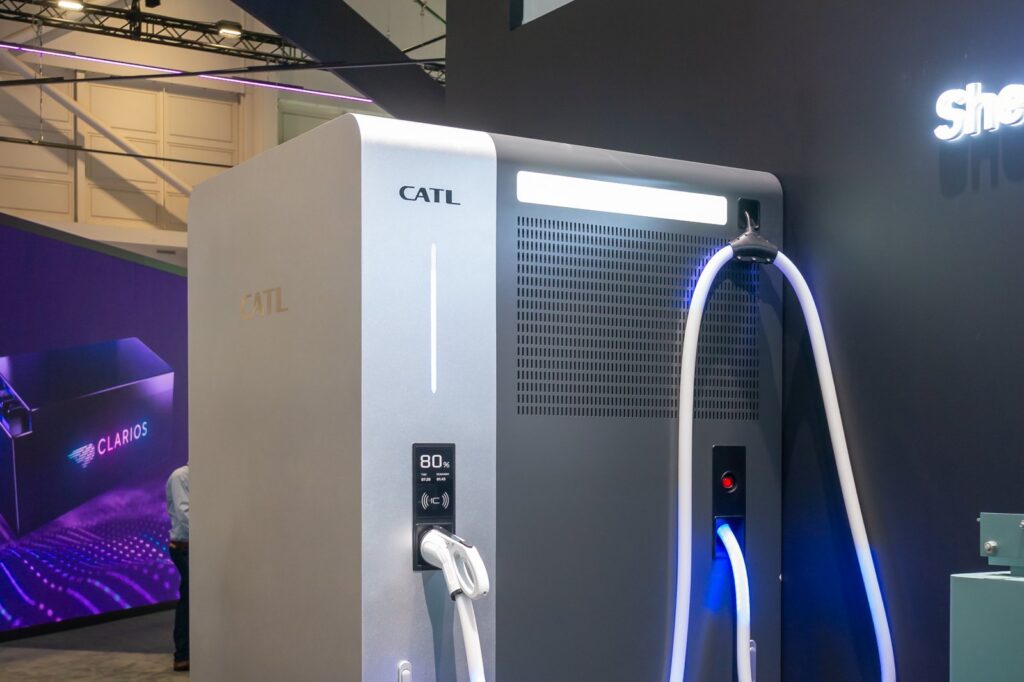
CATL is best known for the batteries inside electric cars. This week in Melbourne it showed what else it wants to power. At All Energy Australia 2026, the Chinese company launched Tener+, a 9-MWh grid storage system, and gave its Tener Sodium system its first public showing in Australia.
Fewer boxes, smaller sites
Here’s what it means in plain terms. Think of a big battery project as a car park full of shipping containers. Tener+ packs more energy into each one, so CATL says a project needs up to 40% fewer containers and a footprint 12% smaller than with conventional systems. Less equipment and less land mean less to build and connect.
The design life is 25 years. Customers can pick cell configurations for their climate and business model, including one tuned for high temperatures and another offering three years of zero degradation. CATL notes the zero-degradation option is not available on every configuration.
Heat gets particular attention. A top-exhaust layout pushes hot air upward, away from neighbouring equipment, which CATL says lets the power conversion systems keep full output through harsh summers. An intelligent thermal management system aims to improve round-trip efficiency and cut the power the system uses on itself. Several units can be commissioned at once with a single click.
Tener+ is the third step in a line that began with the 6.25-MWh Tener in April 2024 and continued with the 9-MWh Tener Stack in May 2025.
Sodium for hot places
Tener Sodium, launched in June, uses sodium-ion chemistry rather than lithium-ion. It comes in modular cabinets and can reach more than 30 MWh at system level. CATL says it runs in ambient temperatures up to 55°C (131°F) and survives more than 10,000 cycles at 45°C. The practical upshot is a battery that should need less cooling in hot regions.
Local partners
CATL signed memorandums of understanding with three Australian partners. With Hitachi Energy it will pair its DC-side battery products with Hitachi’s power conversion systems. EPEC Group will handle grid connection, engineering delivery and system validation, using CATL’s testing institute in Xiamen. And with UNSW Sydney, CATL plans a renewable energy training and innovation centre in Western Sydney. Zane Zhou, head of the company’s Australia, New Zealand and Oceania business, said a battery should be judged across a project’s whole lifecycle, by whether it can meet charging and discharging needs and support customers in the National Electricity Market.
Separately, CATL announced a deal with Germany’s Intilion to deploy 3 GWh of sodium-ion storage in Europe over five years.
The scale behind it
CATL, founded in 2011 in Ningde, Fujian, says it has deployed more than 3,000 storage projects worldwide, with over 17 GWh installed in Australia. SNE Research put its lithium-ion storage battery shipments at 125.0 GWh in the first half of 2026, up 81% on the year and good for a 27.1% market share, the largest in the field.
Sources
- CATL
- CATL confirms Qilin Battery powers Nio Firefly with 560 km range
- CATL unveils 9-MWh Tener+ storage system, deepens Australian presence
Photo: Matti Blume (CC BY-SA 4.0)