
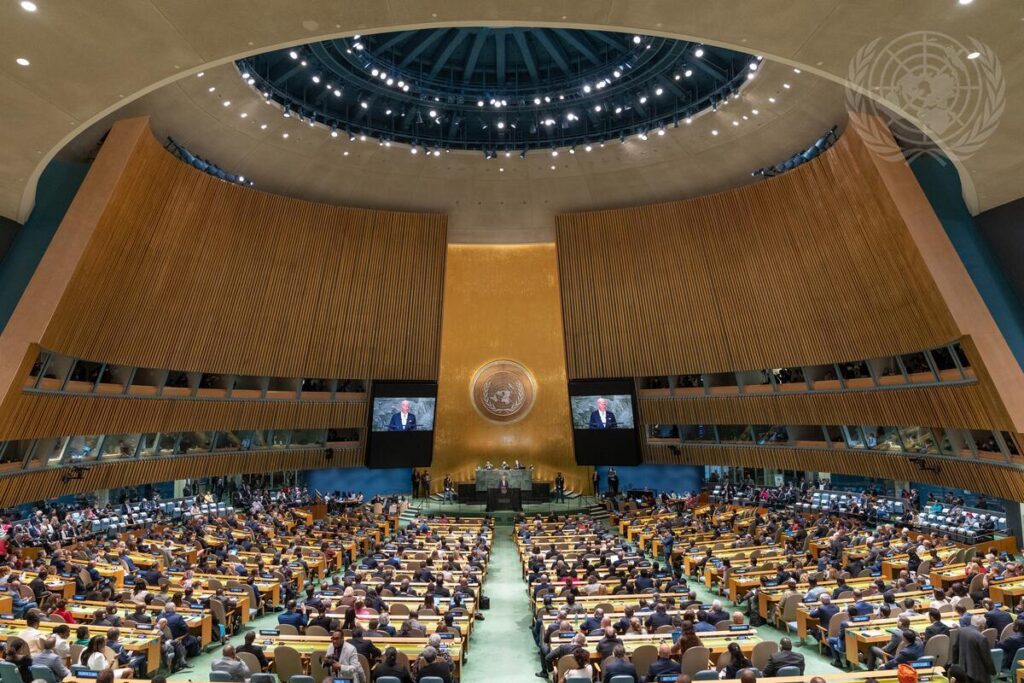
UNITED NATIONS, September 23 — On the sidelines of the United Nations General Assembly, the six founding states of the Global Initiative to galvanize political commitment to international humanitarian law and the president of the International Committee of the Red Cross issued a joint statement calling for renewed respect for the rules of war. The statement was delivered by H.E. Ayman Safadi, Deputy Prime Minister and Minister of Foreign Affairs and Expatriates of The Hashemite Kingdom of Jordan.
He was joined by H.E. Ambassador Mauro Vieira, Minister of Foreign Affairs of the Federal Republic of Brazil; H.E.
Mukhtar Tileuberdi, Minister of Foreign Affairs of the Republic of Kazakhstan; H.E. Ronald O Lamola, Minister of International Relations and Cooperation of the Republic of South Africa; H.E. Fu Cong, Ambassador Extraordinary and Plenipotentiary and Permanent Representative of the People’s Republic of China to the United Nations; Ms. Éléonore Caroit, Minister Delegate for Francophonie, International Partnerships and French Nationals Abroad, attached to the Minister for Europe and Foreign Affairs of France; and Mirjana Spoljaric, President of the ICRC.
A call to attend in Jordan
The statement urged governments to participate at the highest level in the High-Level Conference on Humanity in War, to be held in Jordan on 7 December 2026. The statement announced that, at the invitation of His Majesty King Abdullah II, the Hashemite Kingdom of Jordan will host the High-Level Conference to Uphold Humanity in War on 7 December 2026. Building on the work undertaken through the Global IHL Initiative, the conference will gather state leaders to reaffirm their collective commitment to IHL and translate the momentum generated into action.
A concise and inclusive political declaration will be issued by states at the conference, following broad consultations. All states were invited to join the Initiative, and all participating states were urged to attend the conference at the highest level.
What the Initiative has built
According to the statement, the Global Initiative was launched two years earlier, in 2024, by Brazil, China, France, Jordan, Kazakhstan, South Africa and the ICRC. To date, 118 states from all regions of the world have joined the Global IHL Initiative. Twenty-seven of these states have co-led seven thematic workstreams, developing practical guidance on increasing respect for IHL and addressing the challenges posed by contemporary warfare.
The statement said this guidance builds on a consistent theme that emerged from states throughout the process: the need to preserve and give effect to the protective purpose of IHL. The statement said civilians in more than 130 armed conflicts across the world face unacceptable realities, with hospitals, schools and homes increasingly treated as battlefields.
It described these patterns not as inevitable casualties of war but as deliberate choices to disregard the rules designed to protect people caught up in war.
The conventions under strain
The Global IHL Initiative addresses issues relevant to contemporary armed conflicts and stakeholders worldwide, seeking to ensure the impartial, consistent and universal application of existing IHL obligations. It acknowledges that states bear the primary responsibility for upholding, implementing and applying the Geneva Conventions in all circumstances, including in situations of occupation. The statement also recognized the important role played by the United Nations and the wider multilateral system in promoting respect for IHL and supporting its effective implementation.
Since their adoption in 1949, the Geneva Conventions have helped to protect the lives and dignity of millions of people, the statement noted, while the suffering witnessed in today’s armed conflicts around the world is a stark reminder that the most fundamental rules of these conventions continue to be tested. The ICRC, which describes itself as neutral, impartial and independent, has offices in over 90 countries around the world, providing assistance and protection to people affected by conflict.
What is at stake now is whether the December gathering in Jordan can convert a widening coalition of states into binding practice on the ground. The wider picture will be measured not by the declaration issued in Amman, but by whether the states that have signed on to the Initiative attend at the highest level and carry its guidance into the conflicts already under way.




