
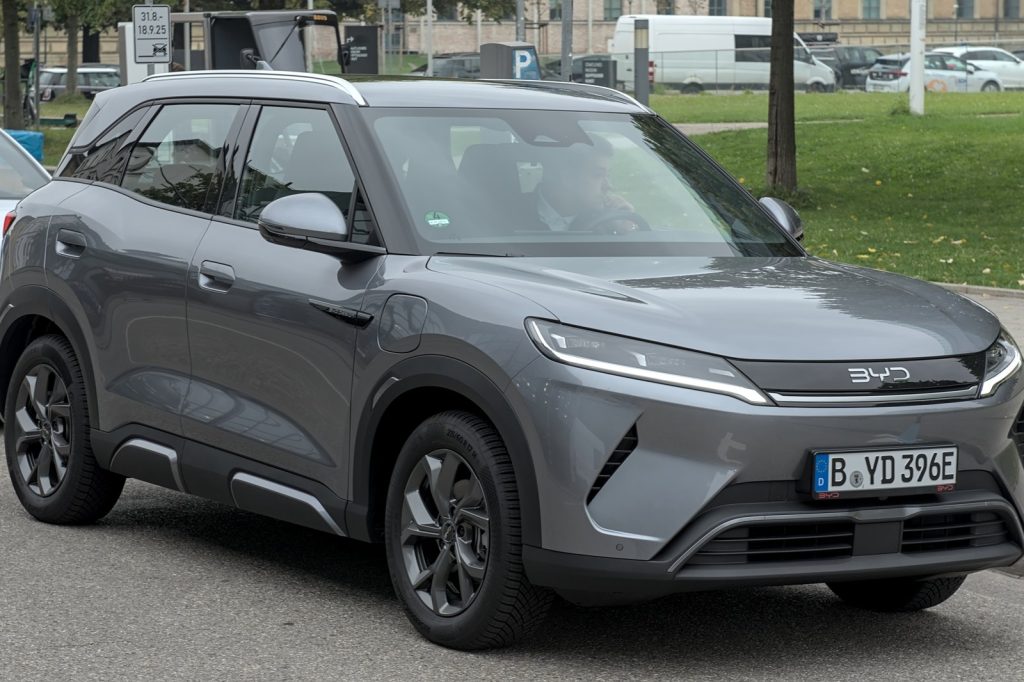
Eight months. That is how long the BYD Atto 2 has been on Australian roads. And already, the Chinese automaker is tearing out the car’s drivetrain and rebuilding it from the ground up.
This is not a new grille and a few extra USB ports. This is a fundamental re-engineering of a vehicle that just hit the market.
Government filings out of China confirm the Atto 2 — sold domestically as the Yuan UP — is switching from front-wheel drive to rear-wheel drive. The charge port is moving from the front wing to the rear. The wheelbase is growing by 150mm, to 2770mm.
Overall length jumps 355mm, to 4665mm. Width increases 65mm, to 1895mm.
Height stays put at 1675mm. These are not minor tweaks. They are a new car wearing the same name.
That 150mm stretch in the wheelbase is the tell. In the EV world, wheelbase is cabin space. BYD is pushing the Atto 2 into a larger segment.
The current car is a small crossover. These dimensions push it into the mid-size bracket, directly challenging the Toyota bZ4X and the Tesla Model Y.
The suspension change backs that up. The rear axle is ditching the semi-independent torsion beam for a full multi-link setup. That is a structural change for better ride comfort and sharper handling.
It is expensive to tool up for. BYD is not doing this for a niche facelift.
Power figures tell a more complicated story. Chinese domestic versions will get 100kW and 120kW motors. That is down from the 130kW in Australian cars today.
But the report signals export models will likely get higher outputs, following BYD’s established pattern. The company routinely reserves stronger powertrains for markets outside China. That suggests the Australian Atto 2 will not be a downgrade in performance, even as the vehicle grows heavier and larger.
BYD is also adding a Lidar unit in the lower grille. It is expected to be optional.
This is the hardware behind the ‘DiPilot 300’ system already available on the Dolphin and the Seagull (known as the Atto 1 in Australia) in China. That is a level of autonomous driving capability the current Atto 2 lacks. It brings the car closer to the tech-forward positioning of rivals like the Xpeng G6.
One piece of BYD’s latest tech is absent. The ‘Flash Charge’ system, which the company has been marketing as a game-changer for charging speed, does not appear in the filing.
That is a notable omission. It suggests BYD is holding that feature for a different model or a later generation. What does this mean for buyers who already own an Atto 2?
Their car is being obsoleted by its own manufacturer in under a year. The resale value of the current front-drive model is a question mark. The new car is larger, has a better suspension, a more desirable drivetrain layout, and optional Lidar.
The old car has none of that. BYD is moving fast.
That is the story. The company is not waiting three or four years for a mid-cycle refresh. It is iterating on an eight-month-old design as if it were a smartphone.
The Atto 2 is becoming a different vehicle. The question for the market is whether that speed is a competitive advantage or a liability for the customers who bought the first version.




