
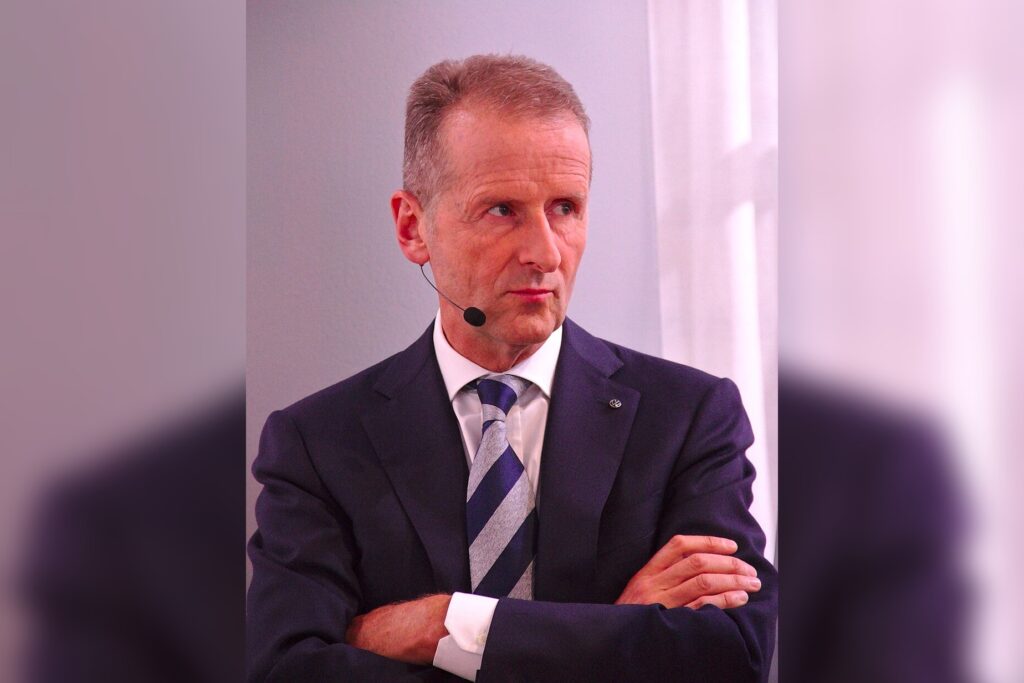
About 8,000 workers stood inside Volkswagen’s Zwickau plant in November 2019 as the first production ID.3 rolled off the line. German Chancellor Angela Merkel and Volkswagen chief executive Herbert Diess were among the guests. The factory had been a big-car plant until recently.
Diess called the car “an important contribution to the breakthrough of e-mobility” and “a milestone for our company on the road to becoming climate-neutral by 2050.” Merkel said Volkswagen was “at the very top of leading the change to e-mobility.”
What it cost to rebuild a factory
Retooling Zwickau took €1.2 billion ($1.32 billion). The plant now runs on 1,700 robots and driverless transport systems for a fully automated line. Diess said the company would spend about €44 billion on future technologies in the coming years, with €30 billion of that set aside for electric mobility.
Volkswagen said six models built on its MEB electric platform, spread across three group brands, were headed for Zwickau. The ID.3 mattered most. The plant was due to build 100,000 electric vehicles in 2020, and the company said it expected up to 330,000 a year from 2021.
All 8,000 employees kept their jobs. Each went through Volkswagen’s e-mobility qualification program, and the team was expected to log 13,000 training days by the end of 2020. “Ultimately, though, it is the people who build the cars who are the key to success,” said Thomas Ulbrich, the brand board member for e-mobility. Diess said conversion and training would finish by the end of 2020, at which point Zwickau would be the largest electric car factory in Europe.
The car itself
The ID.3 made its public debut at the 2019 Frankfurt Motor Show. Online reservations came in so fast that the system crashed. The car is built on the MEB platform and is no larger than a Golf.
Volkswagen did not chase acceleration figures. It aimed at range, agile handling, practical space and a sensible price. The base model was priced under €30,000 ($33,478) before subsidies, with roughly 205 miles of range. The top version was good for about 342 miles. The launch edition, the ID.3 1ST, started under €40,000 with 261 miles of range, free charging for a year and an augmented-reality heads-up display. Deliveries were due to begin in mid-2020.
Ulbrich said an electric car needed 415 to 500 km of range (257 to 310 miles) to sell today. He expected that to drop within a few years as charging networks grow. “If the charging is easy, EVs won’t need heavier and bigger batteries, which ultimately brings the cost down,” he said.
Diess said the ID.3 was not the first electric car, “but it is the first with a long-range, high production quality and high utility value, all for the price of a diesel Golf.”
Price remains the hurdle. Electric cars have usually cost more than gasoline ones. Ulbrich said making them mainstream would take a mix of government subsidies and more charging stations, and satisfied first buyers to convince the rest. Volkswagen also claimed the ID.3’s production was carbon-neutral, with the Zwickau plant using renewable energy for battery cells and the company funding a forest protection project in Borneo, Indonesia, to offset what it could not avoid. Diess said fleet CO2 emissions would fall 30 percent by 2025.
The ID.3 was not headed to the United States. Volkswagen planned to send the ID. Crozz crossover there instead, a nod to American demand for larger SUVs.




