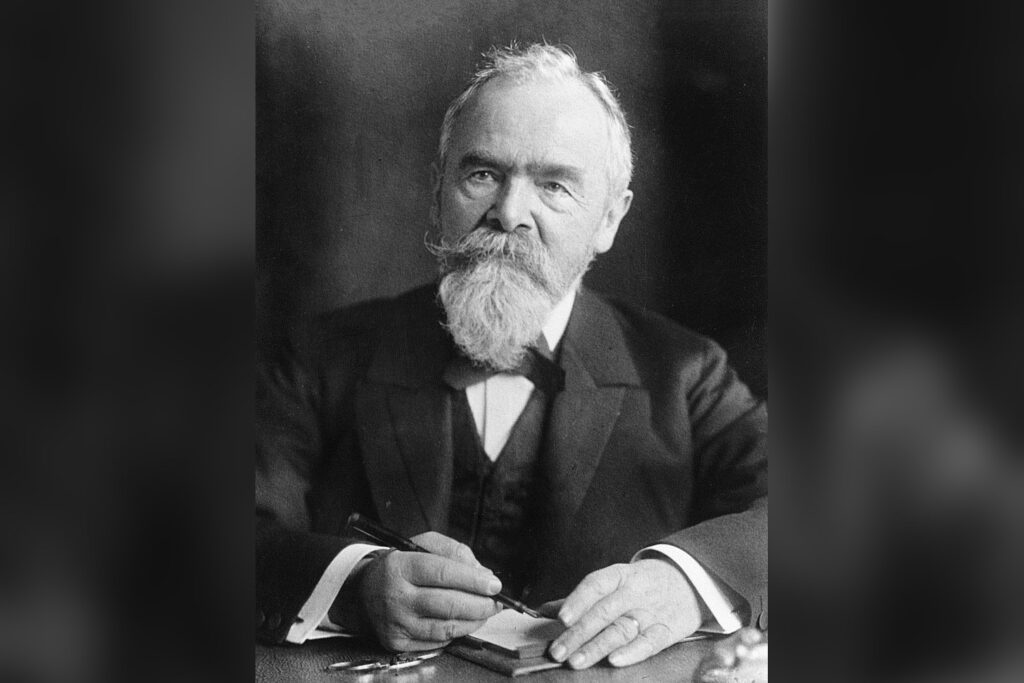
Carl von Linde was a 26-year-old lecturer when he joined Munich’s new Technische Hochschule in 1868. He had applied the moment he heard it was opening. Within four years he was a full professor of mechanical engineering, running a lab where students such as Rudolf Diesel studied.
Born in Berndorf, Bavaria, on 11 June 1842, he was the son of a German-born minister and a Swedish mother, and was expected to follow his father into the church. He went into engineering. His family moved to Munich in 1854, and he began studying at the Swiss Federal Institute of Technology in Zurich. His teachers there included Rudolf Clausius, Gustav Zeuner and Franz Reuleaux. In 1864 the school expelled him for taking part in a student protest, before he graduated.
Reuleaux found him an apprenticeship at a cotton-spinning plant in Kempten. Linde moved on to Borsig in Berlin, then to the new Krauss locomotive factory in Munich, where he headed the technical department. He married Helene Grimm in September 1866. They stayed married for 53 years and had six children.
Cold, then business
Linde published his refrigeration research in a Bavarian trade journal in 1870 and 1871. His first system, built by Maschinenfabrik Augsburg for the Spaten brewery in 1873, used dimethyl ether as the refrigerant. He soon switched to more reliable ammonia cycles, and by 1876 had produced the first reliable and efficient compressed-ammonia refrigerator.
The machines sold. They took up so much of his time that in 1879 he gave up his professorship and founded Linde’s Ice Machine Company in Wiesbaden. Business was slow at first in a weak German economy, then picked up in the 1880s. Breweries were the main buyers, though slaughterhouses and cold stores across Europe bought too. By 1890 he had sold 747 machines.
Liquid air
In 1888 he went back to Munich and his professorship, and soon returned to developing new refrigeration cycles. A 1892 order from the Guinness brewery in Dublin for a carbon dioxide liquefaction plant pushed him toward low-temperature work. In 1894 he began on a process to liquefy air.
It worked in 1895. He compressed air, then let it expand fast so that it cooled, and warmed the liquid slowly to draw off oxygen and nitrogen. He filed for patent protection, though the United States did not grant it until 1903. In 1901 he started on a way to get pure oxygen and nitrogen by fractional distillation of liquid air. By 1910 his son Friedrich and other coworkers had developed the Linde double-column process, and variants of it are still common.
Early oxygen found its biggest market in the oxyacetylene torch, invented in France in 1903, which changed metal cutting and welding in ships, skyscrapers and other steel structures.
Licensing and legacy
Linde knew how to make money from his patents. In 1906 he took a stake in Brin’s Oxygen Company, later renamed the BOC Group, in exchange for his patent rights in the UK and elsewhere, and he held a board seat until 1914. He set up Linde Air Products in the United States in 1907. That company passed through US government control to Union Carbide in the 1940s and eventually became Praxair. Linde plc bought BOC in 2005 and merged with Praxair in 2019, bringing all three of his companies back together.
The Bavarian Crown honored him in 1897 with its Order of Merit, which carried a title, and he became Ritter von Linde. He sat on the board of trustees of the Physikalisch-Technische Reichsanstalt and of the Bavarian Academy of Sciences and Humanities.
From around 1910 he handed running of the company to his sons Friedrich and Richard and his son-in-law Rudolf Wucherer, and kept supervisory and advisory duties. He died in Munich in November 1934, aged 92.