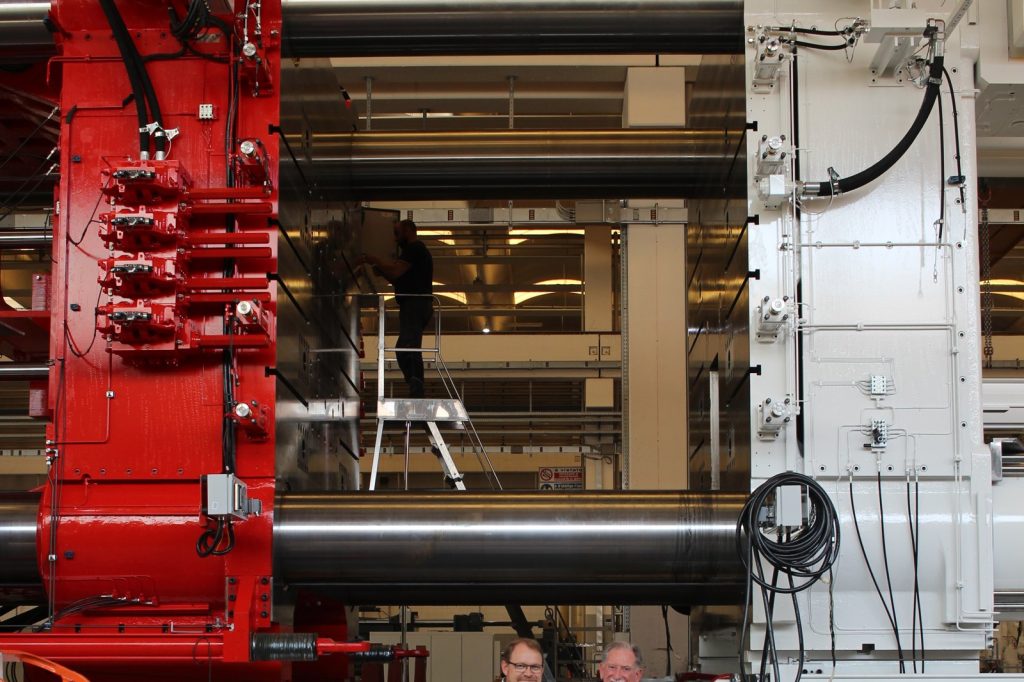
Look at the rear of a Tesla Model 3 and you will find 171 separate metal pieces. Look at the same section of a Model Y and there are two. That gap is the whole story of the Giga Press, a machine the size of a house that has changed how cars are put together, and may change who gets to build them.
Jalopnik reports that the Italian firm Idra Group brought the Giga Press to market in 2018. Two of its engineers, Fiorenzo Dioni and Richard Oberle, invented it, and the pair won the European Inventor Award in 2024. Tesla began using the press in late 2020 to make chassis parts for the Model Y. The result: 1,600 fewer welds than the Model 3 needed.
How the machine works
The principle is simple to say and hard to do. A charge of molten aluminium weighing 80 kg (176 lb) or more is forced into a mould, takes shape as a part and cools fast. The Autopian explains why size matters. Injected metal pushes the two halves of the die apart, and if the machine cannot hold them shut, metal squirts out the sides and the casting is ruined. Tesla’s method relies on clamping forces of 6,000 to 9,000 tonnes. The writer, a former casting engineer, says the biggest machines he worked with at a major automaker were 2,500 tonnes.
Speed is the other half. Cycle times on such machines are often under two minutes, according to the Autopian, and a die set that is looked after can turn out hundreds of thousands of parts. Reuters adds that Tesla developed an aluminium alloy that lets it skip the heat treatment normally used to strengthen a cast part.
What carmakers gain
Reuters noted that a car body typically means more than a hundred stamped metal parts welded together. Cast in one piece, the rear of the Model Y cut related costs by 40%, Tesla has said. Elon Musk has said the approach removed 600 robots from assembly on the Model 3. Lighter cars matter too for EVs, where the battery pack alone can weigh more than 700 kg.
Others are following. Reuters listed Toyota, General Motors, Hyundai and Geely affiliates Volvo Cars, Polestar and Zeekr. Volvo said it would invest more than $900 million to upgrade its plant near Gothenburg, Sweden. Jalopnik adds that Nissan expects to save around $1 billion in development costs on five upcoming models. Behind the headlines sits a business: Reuters cited an AlixPartners analysis putting the global aluminium die-casting market at almost $73 billion in the previous year, heading past $126 billion by 2032. Idra itself has belonged to China’s LK Industries since 2008.
The catch
None of this is cheap or painless. Legacy manufacturers with many models and factory equipment already paid off face a hard decision about spending tens of millions of dollars on new casting technology, analysts told Reuters. A body section cast as a single piece may also be harder or costlier to repair after a crash.
The human side deserves a mention. Jalopnik says factory workers are likely to be on the losing end, since automation usually means some jobs vanish. Tesla itself has not escaped trouble: financial pressure has led it to scale back its casting plans and to cancel the so-called Model 2, the same report says.
Sources
- Explainer – Why are other automakers chasing Tesla's 'Gigacasting'? (Reuters)
- Why Automakers Are Taking Gigacasting Seriously (And No, Tesla Didn't Invent It) (Jalopnik)
- Here's Our First Up-Close Look At The Tesla Cybertruck's Impressive 'Gigacastings' (The Autopian)