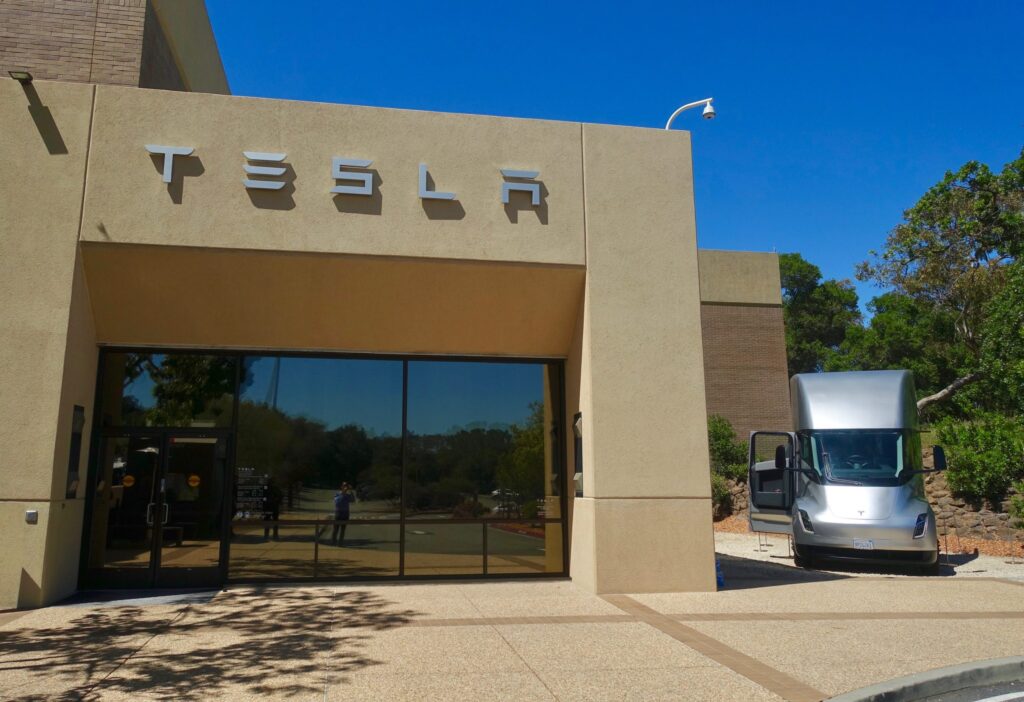
The first Tesla Semi trucks went to customers in late September 2026, nearly ten years after the truck first appeared as a concept in 2017. Tesla marked the occasion with a webcast event late on a Thursday at its new Semi factory beside Gigafactory Nevada in Sparks.
PepsiCo, DHL and US Foods were invited on stage, with trucks bearing their logos parked outside. Other customers named included WattEV, ABF, Einride, IMC and OK Produce.
Elon Musk was in Washington for a state dinner with President Trump and Chinese President Xi, so he spoke by recorded message. “This is really going to be a revolutionary truck,” he said, “that is capable of carrying the heaviest loads over very long distances.” He also told buyers, “I’d recommend placing more orders if you haven’t already, but the waiting list is already pretty significant.”
A long delay
The trucks were supposed to enter production in 2019. The pandemic and a global parts shortage were among the causes of the delay, according to The Verge. Tesla handed a handful of trucks to PepsiCo in 2022, built essentially by hand on a pilot line. The company revealed the final production design in February 2026, and in April it said the first Semi had come off the new line, which it counts as the start of volume production.
Tesla says the plant can build 50,000 trucks a year, or 1,000 a week. It gave no production volume plans and no price at the event. The Verge reported a rumored figure of $290,000 for the long-range version.
What the truck offers
There are two versions: a Standard Range truck rated at 325 miles at a full gross combination weight of 82,000 pounds, and a Long Range truck rated at 500 miles. Dan Priestley, Tesla’s director of Semi truck engineering, said the 500-mile number comes from fully loaded trucks. Vice president Lars Moravy said a Semi pulling a lighter load of about 60,000 pounds could reach roughly 600 miles.
The loaded truck now uses about 1,700 Wh per mile, against an original target of 2,000. That let Tesla fit a smaller, lighter battery. The truck runs on Tesla’s own 4680 cells instead of the bought-in 2170 cells of earlier test units, and Tesla has taken nearly 1,000 pounds off the weight since the first reveal.
The company also swapped hydraulic steering for redundant electric power steering and redesigned the rotor, stator and drive axle.
Charging is the other test. The Semi has an 822 kWh battery, and Tesla’s Megacharger delivers up to 1.2 megawatts per stall. During the event, engineers showed a truck charging from 3 to 60 percent in about 30 minutes. Tesla says it will have more than 30 Semi charging stations by the end of the year.
Orders and doubts
Business is building. Einride announced a 500-truck order in August, IMC Logistics said it would buy 50 Semis for California drayage, and a coalition of large cargo-owning shippers, including Microsoft and PepsiCo, placed an order for 2,500, according to the nonprofit Catalyst Mobility. That is nearly double the existing US fleet of electric Class 8 trucks.
Tesla argues the Semi is cheaper to run than diesel, with diesel in the US at record highs above $6.50 a gallon. Its fleet has shown more than 98 percent uptime, the company says, against 90 to 95 percent for diesel Class 8 trucks. Tesla has not published order numbers, though, and some freight operators have waited years for trucks the company promised long ago. Delays, rising competition and a reversal in US EV policy have already raised questions about demand.
Sources
- PepsiCo, DHL among customers as Tesla kicks off Semi electric truck deliveries
- Here’s the Tesla Semi… again