India’s battery electric vehicle share of new car registrations reached 8.8% in September 2026, surpassing the United States at 6.8%, according to data published by electromobility analyst Eugen Siebert and highlighted by former NITI Aayog CEO Amitabh Kant. The crossover marks a sharp inflection for a market that recorded less than 1% BEV penetration as recently as 2020.
Adoption Curve Accelerates
India’s BEV share climbed from below 1% in 2019 and 2020 to 1% in 2022, 2.2% in 2023, 2.5% in 2024 and 4.3% in 2025 before jumping to 8.8% in September 2026, the data show. The US, by contrast, peaked at 7.8% in 2024 before slipping to 7.5% in 2025 and 6.8% in September 2026. Research by Ember indicates India’s BEV share has exceeded the US every month since April 2026. The comparison rests on market share, not absolute volumes; India still sells fewer electric cars in total than the US.
Broader EV sales in India rose approximately 46-fold between 2016 and 2025, from around 50,000 units to 2.3 million units, according to the Press Information Bureau. EV adoption across all vehicle classes increased from 0.08% in FY2015-16 to 8.26% in FY2025-26. Former NITI Aayog CEO Amitabh Kant emphasised that sustaining the trajectory requires a parallel build-out of charging infrastructure.
Tata Motors Leads Domestic Charge
Tata Motors Passenger Vehicles has been the primary driver of the passenger BEV surge, leveraging aggressive pricing on models such as the Tiago EV and Punch EV alongside a growing portfolio of safety-certified vehicles. The upcoming Sierra EV received a five-star rating in Bharat NCAP crash tests, scoring 30.62 out of 32 for adult occupant protection and 45 out of 49 for child occupant protection, according to results released this week. The assessment covered the fully loaded Empowered 75 kWh QWD variant, with certification extending to PURE, PURE S, ADV and EMP variants in both rear-wheel and all-wheel drive configurations.
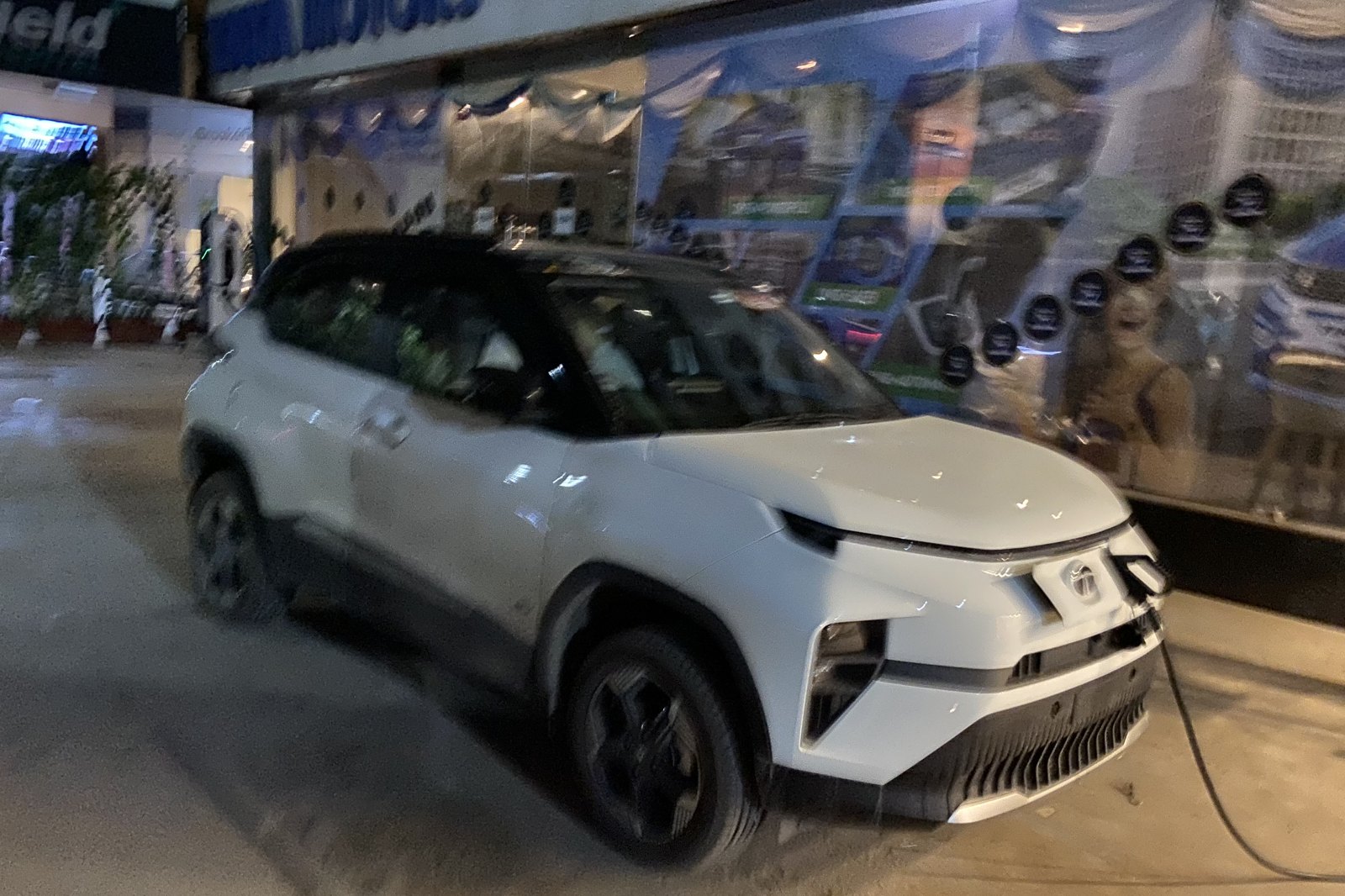
The Sierra EV is built on the Acti.ev+ platform shared with the Harrier EV and offers 63 kWh and 75 kWh battery options. MIDC figures cite a range of up to 665 km for the 75 kWh rear-wheel drive version. DC fast-charging at up to 120 kW can add 263 km of range in one hour.
JLR Margin Cut Weighs on Consolidated Results
The domestic EV momentum contrasts with pressure at Jaguar Land Rover, which contributes about 80% of Tata Motors’ consolidated revenue. JLR cut its full-year adjusted operating margin target to 2-3% from 4% earlier this month, citing weaker demand in China, a mix shift toward lower-margin regions and one-time costs. JLR posted an Ebit margin of 1.1% in the latest quarter despite a 20% year-over-year revenue rise to £5.9 billion. The company flagged an annual free-cash outflow of about £1.25 billion.
Tata Motors Passenger Vehicles shares fell 8.9% on November 16 to close at 261 rupees in Mumbai after the JLR outlook revision. The company reported a consolidated quarterly net loss of 55.31 billion rupees. Analysts maintain a hold rating on the stock. JLR is pursuing £1.7 billion in cost cuts and aims to lower its break-even volume to 300,000 vehicles while rolling out electric Range Rover variants and the Jaguar Type 00, due in 2027.
Corporate Restructuring and West Asia Push
Tata Motors completed a demerger in October 2025, splitting into two listed entities: Tata Motors Commercial Vehicles and Tata Motors Passenger Vehicles. The passenger vehicle entity retains JLR and the majority stake in Tata Technologies.
The commercial vehicle arm is expanding in West Asia. On November 18, Tata Motors Commercial Vehicles announced a distribution partnership with UAE-based Ghassan Aboud Automotive for Syria. Its subsidiary Grand Auto & Machinery Co. will sell cargo vehicles from sub-one tonne to 60 tonnes and passenger vehicles seating nine to 71 passengers, targeting demand from infrastructure rebuilding. The company said West Asia remains a key pillar of its international strategy across more than 50 countries.
Sources
- India’s BEV Share of New Car Registrations Rises to 8.8%, Surpasses US in September 2026 | Autocar Professional
- Tata Motors
- Tata Motors PV Shares Plunge After JLR Cuts Outlook
- India’s Tata Motors PV Falls on JLR Outlook Cut, Weak Chinese Demand
- Tata Sierra EV Scores Five Stars In BNCAP Crash Tests: Here's What The Safety Report Reveals
- Tata Motors enters Syria, partners with Ghassan Aboud for CV distribution
Photo: Raisahabone (CC BY-SA 4.0)