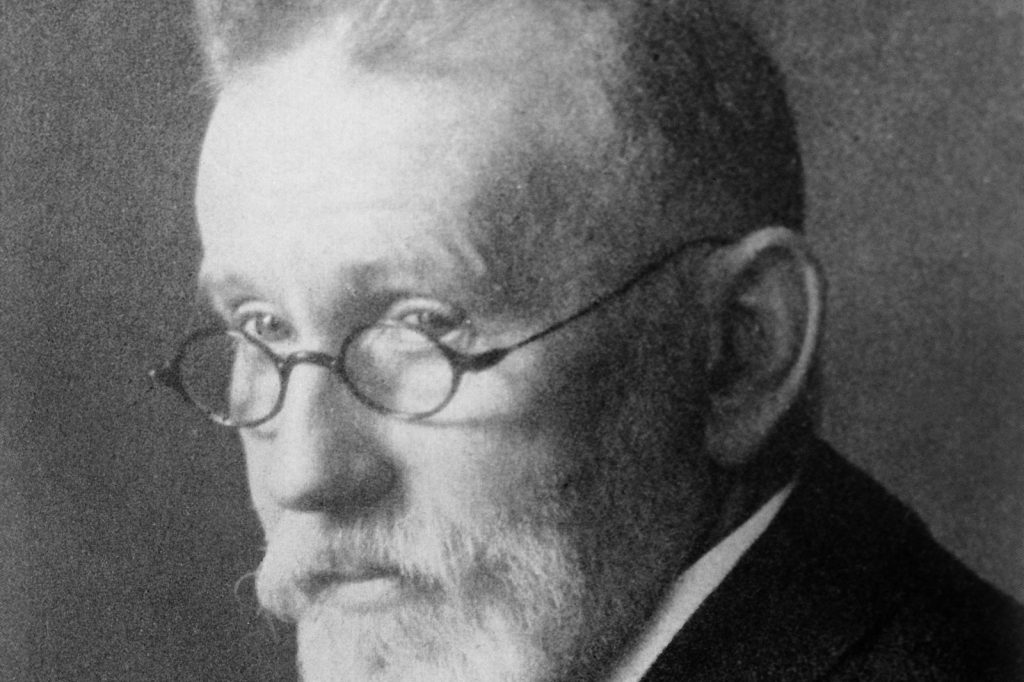
In 1906, Paul Ehrlich predicted that chemists would soon make substances that hunt down specific disease-causing agents. He called them “magic bullets”. A little over a century later, the phrase still describes how drug designers think.
Ehrlich (1854-1915) was born near Breslau, then in Germany and now Wrocław, Poland, and trained as a doctor there and in Strasbourg, Freiburg and Leipzig. In Breslau he worked in the laboratory of his cousin Carl Weigert, a pathologist who pioneered aniline dyes as biological stains. Ehrlich noticed that dyes latched onto particular organs, tissues and cells. He took the idea to Berlin’s Charité Hospital and began testing whether dyes could kill microbes. Methylene blue worked against the malaria parasite.
Antitoxins and a theory
Tuberculosis laid him low, and Robert Koch’s tuberculin cured him. Afterwards Ehrlich turned to bacterial toxins and antitoxins and joined Koch’s Institute for Infectious Diseases in Berlin, alongside Emil von Behring and Shibasaburo Kitasato. One of his jobs was to produce von Behring’s diphtheria antitoxin in quantity and check the quality of the batches the company Hoechst made. In doing so he worked out how to boost immunity systematically and how to make high-grade sera.
His theory pictured living cells covered in side chains that lock onto toxins. A threatened cell grows more of them than it needs, and the extras break off and circulate as antibodies. Those antibodies, searching for toxins, were what Ehrlich first described as magic bullets.
In 1908 he shared the Nobel Prize in Physiology or Medicine with Élie Metchnikoff. Ehrlich had explained how antibodies form; Metchnikoff had studied white blood cells that destroy bacteria directly. By then most scientists agreed that both explanations were needed.
Frankfurt and Salvarsan
A Berlin institute for serum research was set up for him in 1896. It moved to Frankfurt in 1899 and became the Royal Prussian Institute for Experimental Therapy. There he shifted from serum therapy to chemotherapy. With the Japanese bacteriologist Kiyoshi Shiga he synthesized trypan red, a highly effective cure for sleeping sickness.
In 1906 the Georg-Speyer-Haus opened under his direction, with an agreement giving Hoechst and Cassella the right to patent and sell what the institute discovered. Organic chemist Alfred Bertheim and bacteriologist Sahashiro Hata joined the team, and the target widened to the spirochetes behind syphilis.
Starting from an arsenic compound called atoxyl, the group needed three years and about three hundred syntheses to reach Salvarsan in 1909. They tried it first on infected rabbits, then on patients in the final, dementia stage of syphilis. Several of those patients recovered. Later tests showed it worked better early in the disease. Salvarsan and its successor Neosalvarsan (1912) stayed the most effective syphilis drugs until antibiotics arrived in the 1940s.