
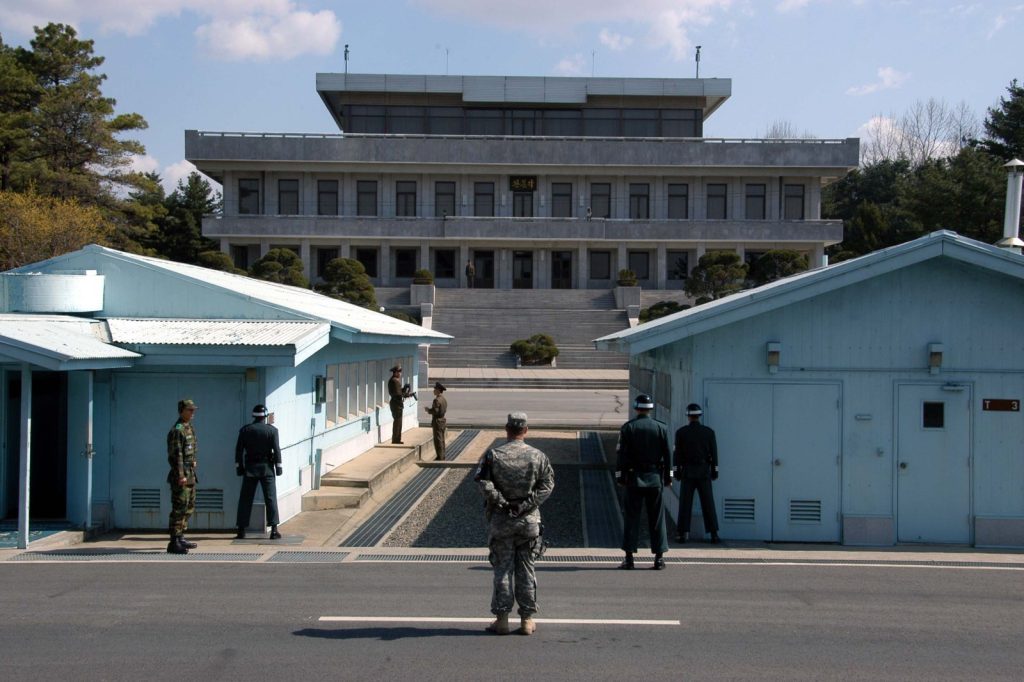
SEOUL, September 25 — North Korea has continued to press ahead with weapons development and deepening military cooperation with Russia, according to state and international reports, even as its southern neighbor deals with the human cost of a heavily fortified border. The most recent incident came on September 21, when the South Korean military said three soldiers were injured during an operation in the heavily mined Demilitarized Zone south of the border.
The DMZ, which separates the two Koreas, is one of the most heavily armed borders in the world, with many of South Korea’s 630,000 troops and North Korea’s 1.2 million troops stationed near it.
A Live-Fire Drill and a New Bridge
On September 14, North Korea announced it conducted a live-fire drill on Saturday during which it simultaneously tested several different weapons systems, including attack drones, tactical ballistic and cruise missiles, and large-calibre multiple rocket launchers. The drill followed the completion of the annual trilateral military exercise, Freedom Edge, between the United States, Japan, and South Korea. Days earlier, on September 7, North Korea and Russia opened their first road bridge, spanning the Tumen river, capable of supporting up to three hundred vehicles per day.
According to Russian Prime Minister Mikhail Mishustin, the bridge is to be used to transport cargo and, by the end of the year, passenger traffic. North Korean media claimed the bridge is solely for tourism and trade, while Ukrainian analysts warned it was designed as a military logistics corridor to support Russia’s war in Ukraine.
The competing accounts indicate how the same infrastructure can be read differently depending on where an observer sits. On September 6, Kim Jong Un commissioned the country’s second naval destroyer, declaring it part of North Korea’s nuclear response system and warning that the time has come to exercise its sovereignty “at sea and underwater.”
A Long Standoff, and a Recent Shift
The Korean peninsula has been divided since the Korean War of the early 1950s, when the United States supported forces in the south against communist forces in the north, who were aided militarily by China and the Soviet Union. Today, the United States is committed to defending South Korea under a mutual defense treaty, with nearly 29,000 troops deployed on the peninsula. Under Kim Jong-un, who inherited the title of supreme leader from his father and grandfather, North Korea has pursued nuclear weapons and ballistic missiles to guarantee regime survival.
In violation of UN Security Council resolutions, it continues overt nuclear enrichment and long-range missile development. U.S. intelligence agencies estimate that North Korea has enough plutonium to produce at least six nuclear weapons, and possibly up to sixty, though the scale of its uranium enrichment program remains uncertain.
In September 2017, North Korea conducted its sixth nuclear weapons test, its most powerful to date. It also claimed to have developed a hydrogen, or thermonuclear, bomb. In the same year, the country conducted its first successful test of an intercontinental ballistic missile, and U.S. intelligence agencies determined that North Korea could miniaturize its nuclear weapons to fit inside a missile.
However, North Korea has not yet demonstrated that its nuclear warheads can withstand reentry into Earth’s atmosphere. Decades of negotiations have so far failed to curb the program.
In response to the increasing frequency of missile tests, the United States has deployed the Terminal High Altitude Area Defense system in the Seongju region of South Korea, one hundred and fifty-five miles from the northern border. Japan, South Korea, and the United States maintain unilateral sanctions on North Korea, and the UN Security Council has passed harsh multilateral sanctions. At home, Kim has detained between 80,000 and 120,000 political prisoners, purged high-ranking officials, and likely ordered the assassination of his half-brother.
He has also deepened ties with Russia, providing artillery and troops for the war in Ukraine. On August 16, President Donald Trump announced in a social media post the reduction of annual joint military exercises between the United States and South Korea, citing his close relationship with Kim Jong Un as well as South Korea’s refusal to support the U.S. war with Iran. The CFR Global Conflict Tracker lists the confrontation with North Korea as an interstate war with critical impact on the United States and status developing.
What to watch next is whether the reduced exercises hold, and whether the Tumen river bridge becomes the cargo route its builders describe or the military corridor Ukrainian analysts warn of.




