
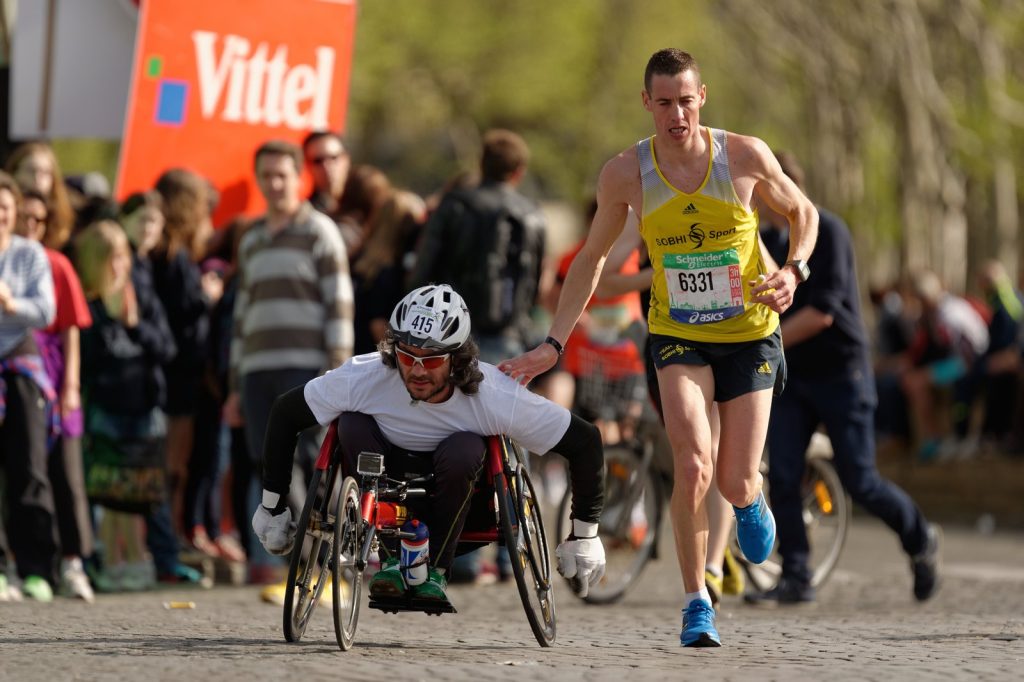
Training Ground for Inclusion
For athletes who use wheelchairs, a major urban race has not always been a realistic target. For decades, mass-participation road races were built almost exclusively with bipedal participants in mind. Course layouts, timing mats, and aid stations all assumed a person on foot. Wheelchair users were often absent from these events either because the routes were physically impassable or because organizers had not planned for their inclusion. That began to change slowly over the last several decades, driven by advocacy and growing awareness among race directors.
The Wastside Smiles event served as a practical stepping stone for Jackson and Hunter. Competing there allowed them to gauge how their equipment handled the same hills, turns, and finish line that other participants navigate. It also provided a chance to test their pacing and endurance on a route that, like the Scottish Run’s course, was built to accommodate wheelchairs. For the wider field of runners, sharing the road with wheelchair athletes normalizes the sight of different modes of movement within a single pack. That cultural shift, while gradual, is a meaningful change in how public sporting spaces are understood and used.
The AJ Bell Great Scottish Run is an annual road running event held in Glasgow, offering multiple distances. It is one of Scotland’s premier mass-participation races, drawing thousands of entrants each year. Its organizers have made a deliberate effort to design courses that can be walked, run, or rolled, making the event accessible to wheelchair users alongside traditional runners. This approach transforms the race from a closed door into a viable goal for athletes who use wheelchairs.
Redesigning the Route
The Scottish Run’s approach stands in contrast to the older model of road racing, where wheelchair divisions were often afterthoughts. In that model, wheelchair categories were added as separate, separate categories rather than integrated into the core design of the event. Here, the route itself becomes the equalizer: the course is designed from the start to be navigable by wheelchairs, not as a bolt-on feature but as a built-in element.
The practical consequence for athletes like Jackson and Hunter is that a major event such as the Scottish Run is now a viable target, not a closed door. The Wastside Smiles event gave them a chance to test the same principles on a smaller scale. For the wider field, it means sharing the road with athletes who are navigating the same geography, just with a different set of mechanics. This normalizes wheelchair users within the pack, a small but meaningful cultural shift.
As more athletes like Jackson and Hunter use smaller local races to prepare for the Glasgow main event, the pressure will likely grow on other major UK road races to follow the same design playbook. The question for course designers is whether they will treat accessibility as a feature to be bolted onto an existing route, or something built in from the start. The Scottish Run’s model suggests that integration from the outset is both possible and practical.
The background of this shift is rooted in advocacy and awareness that have slowly pushed race directors to consider a wider range of participants. For decades, road races were designed almost exclusively for bipedal runners. Now, events such as the Wastside Smiles community race are proving that routes can accommodate walking, running, and rolling. That transformation, while gradual, has the potential to reshape not just individual events but the entire culture of mass-participation road racing in Scotland and beyond.




