
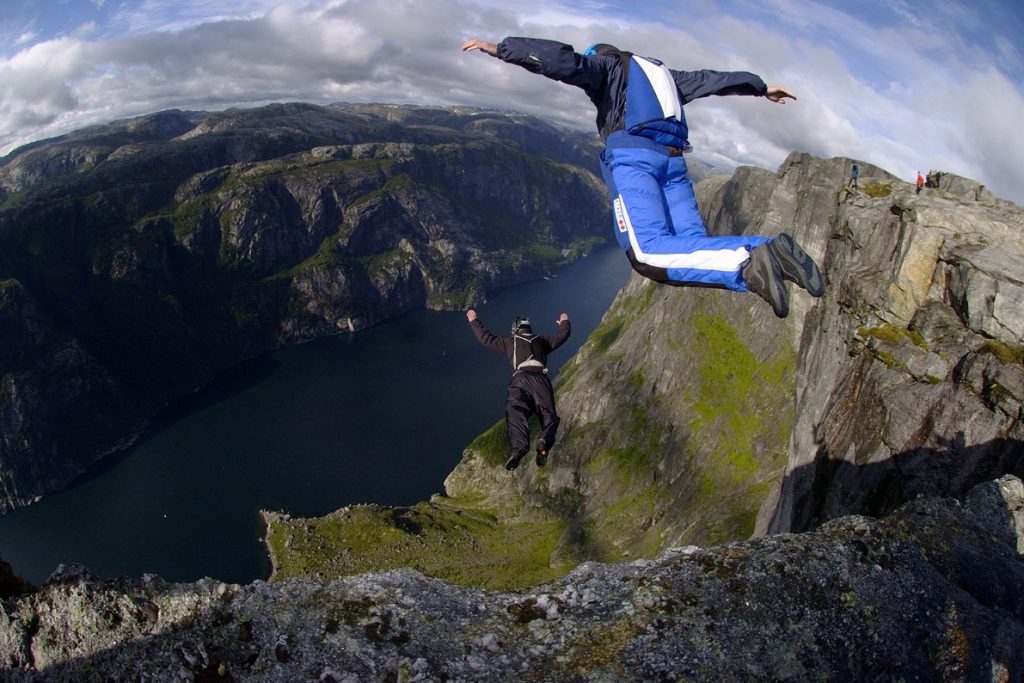
NEW YORK, July 26 — In 1978, the filmmaker Carl Boenish coined the term BASE jumping, an acronym that would become shorthand for a fringe pursuit: leaping from fixed structures — Buildings, Antennas, Spans (bridges), and Earth (cliffs). The sport claims a fatality rate of roughly 1 in 2,300 jumps, a figure that dwarfs the 1-in-100,000 risk associated with recreational skydiving. That disparity is central to the sport’s outlaw reputation.
BASE jumping remains unregulated in many jurisdictions; participants routinely face trespassing and reckless endangerment charges. The legal landscape is hostile: jumping is illegal in most national parks — including Yosemite, where Boenish himself made the celebrated El Capitan jumps that drove the sport’s growth in the 1980s — and in many urban areas.
The timeline: from fatal first to modern stunts
The first documented BASE jump from a building occurred in 1912. Franz Reichelt jumped from the Eiffel Tower. It was fatal.
On the modern timeline, two high-profile urban jumps illustrate the risks and the legal stakes. In 2013, an individual jumped from the Empire State Building.
In 2019, another jumped from the Burj Khalifa. Both incidents drew law-enforcement attention; the sport’s practitioners operate in a gray zone between adrenaline tourism and criminal trespass. The Space Needle, at 605 feet, is considered on the low end for a BASE jump.
The sport’s typical minimum height for a reserve parachute to open is 200 to 300 feet. At those altitudes, jumpers have a window of roughly two to three seconds to deploy their parachute after exit.
The margin for error is razor-thin.
Unregulated, uncounted, unyielding
The record shows no central authority tracking the total number of BASE jumps or fatalities globally. The 1-in-2,300 figure is derived from periodic surveys and community tallies, not from official reporting. In contrast, skydiving fatalities are tracked by national aviation bodies — the Federal Aviation Administration in the United States, for example — and the rate has been stable for years at about 1 in 100,000 jumps.
Proponents argue that BASE jumping is a legitimate test of human skill and nerve, a logical extension of parachuting from aircraft. Critics counter that the risks are avoidable and that the sport imposes costs on emergency services and public lands.
In national parks such as Yosemite, where the cliffs of El Capitan draw climbers and hikers, the ban on BASE jumping is enforced with fines and, occasionally, criminal charges. Boenish’s own legacy is mixed. He coined the term and popularized the activity, but he also died in a BASE-jumping accident in Norway in 1984.
The sport he named continues, largely underground, in the gaps between regulation and gravity. What to watch next: law-enforcement responses to urban jumps, especially in cities where skyscrapers and public safety collide.
The 2019 Burj Khalifa incident and the 2013 Empire State Building jump remain reference points for prosecutors. With no federal framework in place, state and local statutes define the sport’s legality — file by file, charge by charge.
Sources
{“@context”: “https://schema.org”, “@type”: “NewsArticle”, “headline”: “BASE Jumping: Illicit Sport Blending Parachuting and Landmark Scaling”, “description”: “NEW YORK, July 26 — In 1978, the filmmaker Carl Boenish coined the term BASE jumping, an acronym that would become shorthand for a fringe…”, “datePublished”: “2026-07-26T09:30:00+00:00”, “author”: {“@type”: “Person”, “name”: “Ariel Antonio”}, “publisher”: {“@type”: “Organization”, “name”: “InfoPulse Today”, “url”: “https://newsfeed.infopulsetoday.com/”}, “citation”: [{“@type”: “CreativeWork”, “url”: “https://en.wikipedia.org/wiki/BASE_jumping”}]}




