Your EV’s battery is big enough to run your house — here’s what stops most people. Getting the energy into the house remains complicated and expensive, leaving the vast majority of owners unable to tap the storage they already own.
The Battery You Already Paid For
A typical electric vehicle stores about 74 kWh of energy, over five times the 13.5 kWh capacity of a Tesla Powerwall, the most popular brand of home batteries. Cars sit parked roughly 95% of the time, and daily driving uses only an eighth of a full charge, so most of that storage capacity goes unused. In 2024, U.S. electricity customers lost power for an average of 11 hours, nearly twice the annual average of the previous decade. The theoretical case for vehicle-to-home (V2H) backup is straightforward: hundreds of thousands of American households already own a battery large enough to ride out those outages, and it is parked in the garage.
Why the Charger Must Be Bidirectional
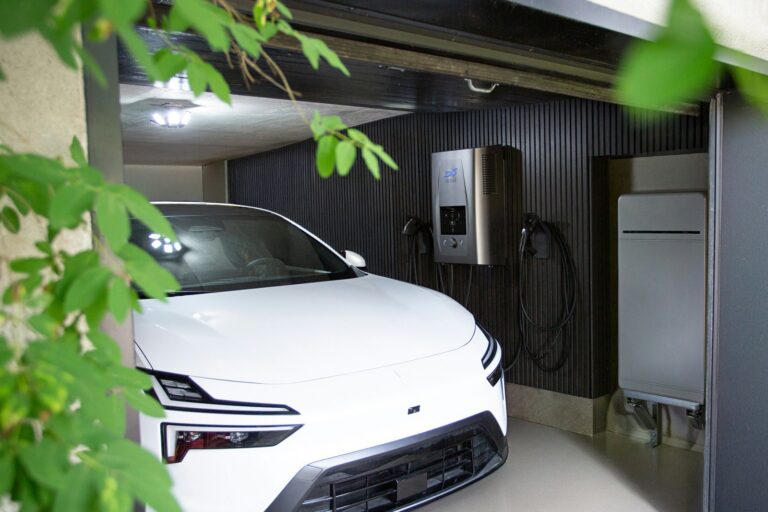
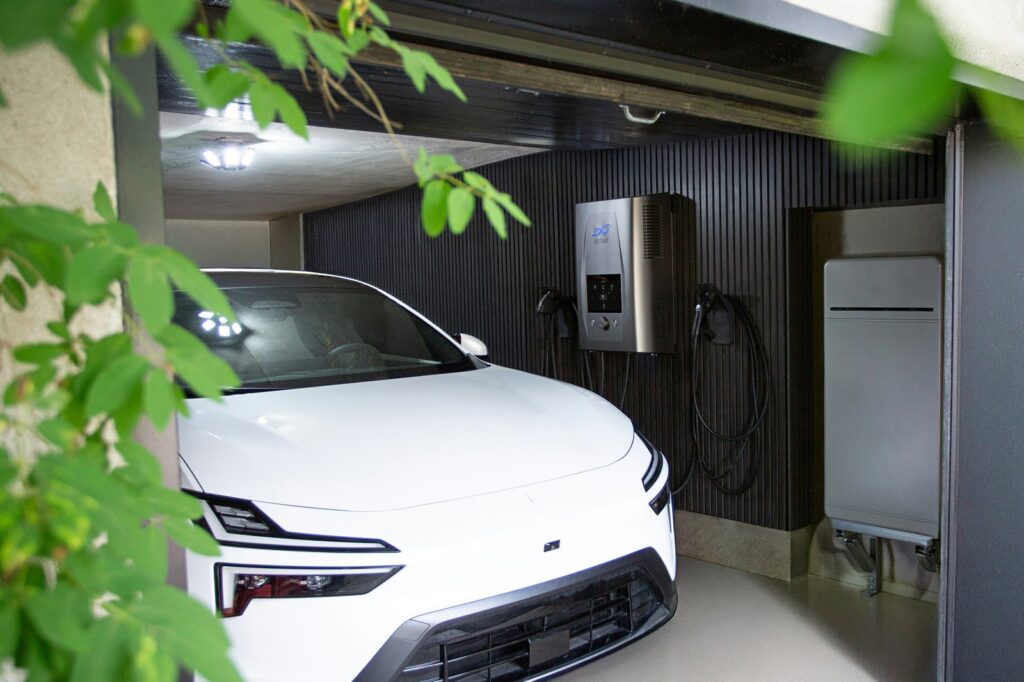
The technical reality is that a typical charging connection does not work in reverse. To turn an EV into a home backup system, the vehicle must support bidirectional operation and connect to a compatible V2H system. That system requires a DC-to-AC inverter — EV batteries deliver direct current, while household electrical systems run on alternating current — and an islanding or transfer switch to disconnect the home from the grid safely. The point is to power your home, not energize grid wiring during an outage. V2H powers whole-home circuits, unlike vehicle-to-load (V2L), which only powers individual devices via built-in outlets.
Onboard Inverters: The Ford Fathom Approach
Hardware architectures differ. The Ford Fathom includes an onboard DC-to-AC inverter supplying over 10 kW AC power, eliminating the need for an external inverter. The inverter is built into the vehicle’s E-Box, one of its five main electrical modules. This contrasts with the F-150 Lightning’s home backup system, which required an external DC-to-AC inverter (the Ford Charge Station Pro) and a Home Integration System transfer switch. The Tesla Cybertruck is another example of a vehicle with a built-in DC-to-AC inverter. Even with an onboard inverter, the Fathom still requires an external bidirectional charger — Ford’s Home Power Station — and a Home Backup Panel to move electricity between the truck and the home.
Tesla’s Powershare and the Software Gatekeeper
Tesla’s Powershare in North America requires a Powerwall and Gateway for whole-home backup, adding significant cost. In Australia, a software update from the 2026.38 branch, rolling out since October, blocks third-party bidirectional chargers such as Sigenergy that owners had been using for V2H. Owners report power stopping after about three minutes with a battery management alert, or after 15 to 20 minutes regardless of load. The release notes cited “security improvements” and minor fixes. The same software branch delivered Powershare with Powerwall to owners in the U.S. and Canada, but Tesla Australia has said Powershare cannot be retrofitted to existing vehicles and is vehicle-to-load only there. Australian owners are left with neither Tesla’s solution nor anyone else’s.
Transfer Switches, Permits, and Utility Rules
A whole-home or selected-circuit backup requires compatible power conversion equipment and a safe way to disengage the home from utility power. Utility interconnection agreements and permits are required for grid-export capability, adding time and complexity. The car has to be at home, connected, and sufficiently charged. Every unit of energy used by the house is energy no longer available for driving. Air-conditioning and electric heating are heavier workloads and will gobble up runtime substantially.
The Cost Breakdown
Standard home EV charger installation averages $400–$700 for hardware alone, not including bidirectional hardware or electrical upgrades. Bidirectional DC chargers such as Sigenergy and Fermata cost several thousand dollars before installation. Ford’s first-generation bidirectional charger, the Charge Station Pro, debuted at $1,310 in 2022; the entire backup system with the Home Integration System cost $5,205. Ford says the new Fathom hardware will run about 40% of that, roughly $2,000. Full V2H installations with transfer switches and panel upgrades commonly exceed $10,000. A home system for bidirectional charging costs $3,000 to $7,000 for the hardware alone — much less than the $10,000 to $15,000 needed for a standalone home battery, but still a significant barrier.
Sources
- Your EV's battery is big enough to run your house — here's what stops most people – Engadget
- Vehicle-to-grid
- How EV batteries can help keep the lights on and clean our air
- The Ford Fathom's Home Backup System Will Be Way Cheaper Than The F-150 Lightning's
- Save Gas, Save Time, Save Money: We Test the Top EV Chargers to Find the Best for Your Home
- Who Controls the Battery in Your Driveway? – CleanTechnica
Photo: dcbel / Unsplash (Unsplash License)