
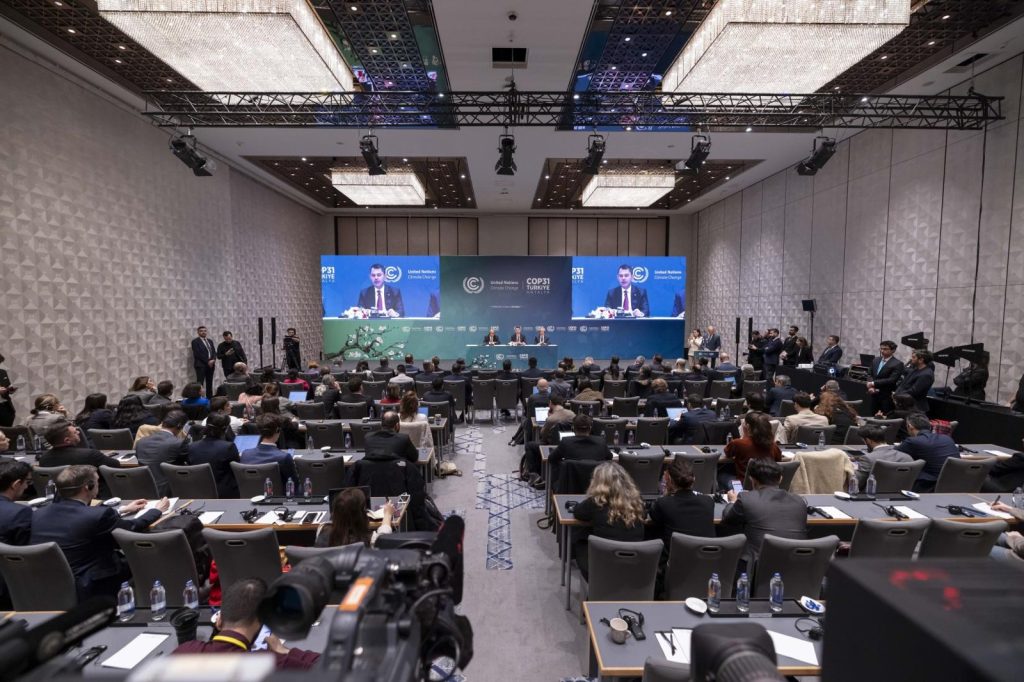
Climate negotiators chose to hold this year’s pre-COP31 meeting in the Pacific so the people most exposed to rising seas could not be ignored. Australia, which has the new role of president of negotiations at COP31, pushed for the venue. The talks opened in Fiji on Monday, and the final stage took delegates to Tuvalu.
Turnout of heads of government was thin. Only 13 national leaders joined Australian Prime Minister Anthony Albanese in Nadi, most of them from the Pacific, the Guardian reported. The war, a historic energy crisis and an unpredictable, climate-denying US administration all weighed on attendance. Still, about 30 ministers came, along with representatives of China and Saudi Arabia and roughly 4,000 other participants.
Seeing Tuvalu first-hand
On Tuesday a delegation flew to Tuvalu, an atoll nation of about 10,000 people that sits only around 2 metres above sea level. Visitors toured a 20-hectare land reclamation project. Melelusi Sokotia, 13, told them her friends’ hopes of becoming “teachers, doctors, builders” were being crowded out by the question of whether they could “grow safely here in Tuvalu.”
Tuvalu’s climate minister, Maina Vakafua Talia, said the island’s fate “will be defined by the major polluters” and hoped visitors would look for “solutions that will keep us afloat.” Albanese called climate change “a daily reality” for the Pacific. Anne Rasmussen, lead negotiator for the Association of Small Island States, described how at low tide families can see house foundations and ancestors’ burial grounds, while salt creeps into fresh water and bleaching hits the reefs that feed local incomes.
Money and fossil fuels
Pacific leaders repeated three demands: keep the 1.5C limit alive, make climate finance easy to reach for poor communities, and put ocean health first. Australia’s climate minister, Chris Bowen, said only 0.2% of global climate finance goes to helping small island states adapt. The countries that need it most, such as Tuvalu, “get it the least,” he said.
Turkey’s climate minister, Murat Kurum, who will preside over COP31, told the Guardian that wealthy countries should spend “much more” on climate than the 5% of GDP Nato members have promised for defence. “The climate issue is the security issue itself,” he said. Spending before disasters costs one unit; after them, ten.
On fossil fuels he was more guarded. He said the world was “already in a transition” and doubted that more progress on that wording was possible. Both host countries backed a statement in Fiji supporting a global transition away from fossil fuels, yet both drew accusations of hypocrisy for supporting new coal and gas projects. Tzeporah Berman of the Fossil Fuel Non-Proliferation Treaty Initiative said a phase-out “means no new projects.”
The stakes are measurable. A UN environment report found that even in the best case warming would reach at least 1.8C. COP31 takes place in Antalya from November 9 to 20.
Sources
- Cop31 host urges wealthy countries to spend ‘much more’ on climate than defence
- Pacific Islands urge world leaders to act on climate crisis
- Tuvalu urges world leaders to seek Pacific climate solutions ahead of COP31 in Türkiye




