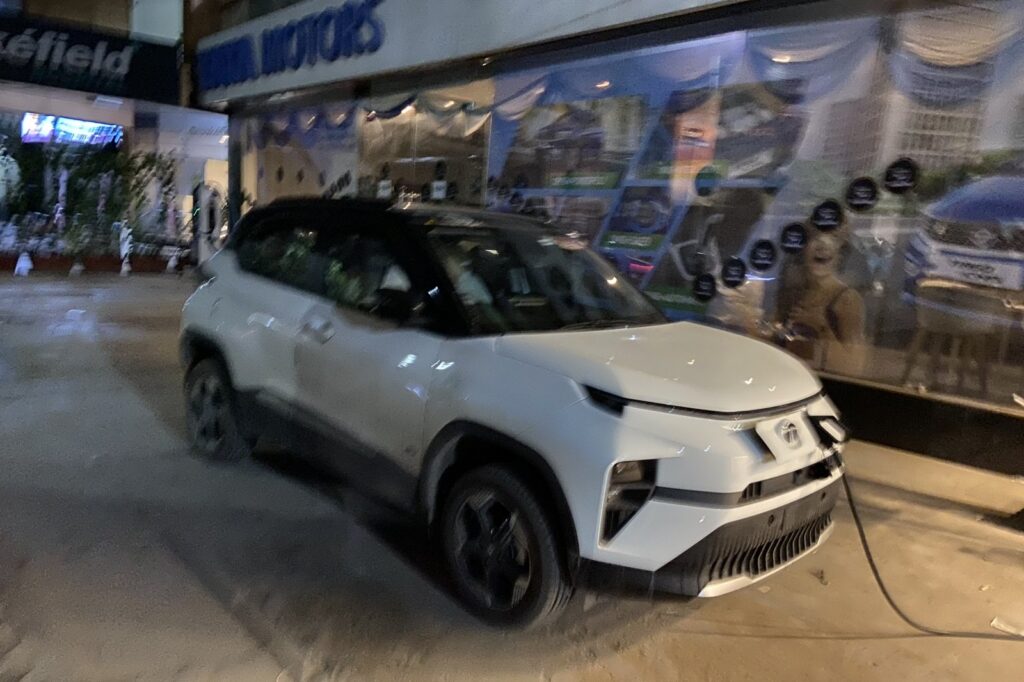
October 2026 wholesale dispatches of the Tata Punch.ev exceeded 5,000. No standalone electric passenger car model in India had previously crossed that threshold in one month.
The Auto Punditz figures place an entry-priced electric SUV at a volume previously unreached by a single Indian EV nameplate. They measure vehicles sent to dealerships, however, not registrations or customer deliveries.
That distinction matters when judging whether October marks sustained consumer demand. Festive-season purchases and dealer stocking can influence a single month’s wholesale result.
A narrow contest before the record
The Punch.ev led India’s electric passenger car chart in three of the four months through October. Mahindra’s XEV 9S interrupted that run in August, dispatching 4,508 vehicles against Tata’s 4,430.
Tata moved back ahead in September by 66 units, with 4,702 dispatches to the Mahindra model’s 4,636. October then carried the Punch.ev beyond 5,000.
Reported growth was approximately 6.1% month on month in September and at least 6.3% in October.
The two vehicles occupy different size and price categories. Their rankings illustrate changing leadership in electric sales rather than a direct comparison between equivalent products.
Price and battery choices
Following a September 2026 revision, the Punch.ev range costs ₹9.79 lakh to ₹12.99 lakh ex-showroom. A Battery as a Service structure reduces the initial vehicle price by charging separately for battery use.
That arrangement requires buyers to compare total ownership costs rather than treating the lower entry figure as the entire purchase expense.
The 30 kWh version has an ARAI-certified range of 365 km, while the 40 kWh pack is rated at 468 km. Outputs are 88 bhp and 129 bhp respectively, with both producing 154 Nm.
A single-speed automatic transmission sends power to the front wheels. From rest, the Long Range model takes around 9 seconds to reach 100 kph; its top speed is 140 kph.
Battery warranty coverage differs substantially. For 15 years from registration, the first private owner of the larger pack has unlimited-kilometre coverage. The smaller pack is covered for eight years or 1.6 lakh km.
Depending on trim, equipment includes ventilated front seats, a 360-degree camera, blind-spot monitoring, wireless Android Auto and Apple CarPlay, cruise control and a voice-assisted electric sunroof.
Six airbags, electronic stability control and ISOFIX mounts are included in the safety specification. The model has a five-star Bharat NCAP rating.
Tata’s strongest passenger vehicle month
The model’s result formed part of Tata Motors Passenger Vehicles’ highest monthly total: 75,426 domestic and international sales, up 23% from 61,295 in October 2025.
Domestic volume reached 73,894 vehicles, compared with 61,134 a year earlier. International sales increased to 1,532 from 161.
The company also ranked second in October passenger vehicle registrations on the Vahan data it cited. Its estimated market share improved by approximately one percentage point, while Maruti Suzuki remained first.
Tata reported its highest monthly bookings during the festive period. Demand for some electric and CNG models exceeded supply, prompting plans to increase production and improve availability.
Competition beyond Mahindra
Maruti Suzuki’s electric range could grow beyond the e Vitara through a smaller vehicle aimed at a more accessible segment. Its name, body style, battery, range, pricing and launch date have not been confirmed.
Reports point to another Maruti EV appearing in 2027, but that could be either the smaller car or the planned YMC three-row electric MPV.
For Tata, the immediate market test is more concrete. Repeating monthly wholesale volumes above 5,000 would provide stronger evidence than October’s festive-season result alone.
Charging access, real-world range and service remain central to buyers’ decisions. Production will also determine whether dealers can convert reported demand into deliveries.
The October benchmark therefore belongs to the Punch.ev, but its durability will be measured in subsequent monthly dispatch reports.
Electric vehicles contributed 16,244 sales, up 74.9% from 9,286. Their share of Tata’s passenger vehicle total rose to around 21.5% from 15.2% a year earlier.
Sources
- Tata Punch.ev crosses 5,000 monthly dispatches for first time, sets new benchmark for India's EV market | Mint
- Tata Punch
- Maruti’s Upcoming Small EV Could Rival the Tata Punch EV
- Tata Punch EV Creates History: First Electric Car in India to Cross 5,000 Monthly Sales
- Tata Motors October sales hit 75,426 units, CNG and EV demand exceeds supply
- Tata Punch.EV Becomes First Electric Car To Cross 5,000 Monthly Sales Mark
Photo: VideshiBhaktNRI (CC0)