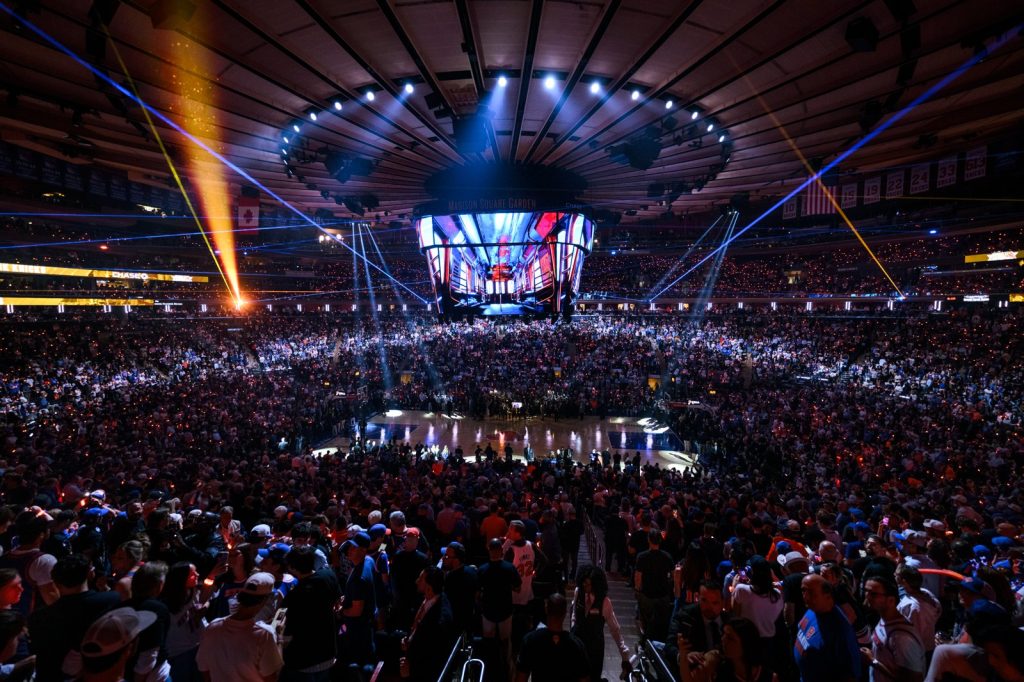
NEW YORK — For Knicks fans who stayed up past midnight hoping for a new toy, draft night delivered a math lesson instead. The team entered Tuesday’s first round holding the 24th pick, traded back three times, and finished the night holding the 47th pick plus four extra future second-rounders whose identities will be settled later. As of Wednesday morning, New York was lined up to pick at 31, 47 and 55 in round two, with fresh speculation it would deal again.
The reason, in plain terms, is the salary cap. The front office is treating the second apron like a hard ceiling it will not cross. Unlike the past two years, when the team was literally hard-capped, it had room to go over this time and chose not to. Barring a change of heart, the Knicks will stay beneath the second apron in 2026-27 while defending their championship.
Here is what it means for people who just want a better bench: every draft dollar counts. The 24th slot carried a rookie scale of $3,325,000 against an estimated veteran minimum of $2,457,000, a gap of $782,000. By trading out of the first round entirely, the Knicks bank that full difference; the pick swap with the Lakers alone shaved another $130,000. Small money, but with two players about to hit free agency demanding sizable salaries, pennies compound.
The accounting gets friendlier from there. New York now counts $16.9 million of second-apron room while needing to fill five roster spots; at six spots, and depending on Jose Alvarado’s player option, the headline figure is $21.4 million. Discount those spots at the vet minimum and, if Alvarado opts in, the effective room is $4.63 million — enough to lift one signing to $7,087,000 in year one, above the taxpayer mid-level exception.
The second-round exception works like a cheat code. Under the current CBA, a team can ink any second-rounder to a three-year contract worth $6 million, with a year-one salary of just $1,361,000, which sits $1,096,000 below the vet minimum. Keep pick 31, for instance, and draft someone like Isaiah Evans, a target at 24 who slipped: he costs nearly $2 million less than a minimum veteran and frees roughly an extra million of effective space, lifting the first-year ceiling for an outside signing toward $8,183,000. Two such deals push it to $9,279,000.
Closer to home, that is the Shamet question. A hypothetical four-year, $32 million deal for Landry Shamet starts around $7 million, which devours the room on its own; each second-round exception carves back space to add another veteran at as much as two years, $7.46 million in all, or $9.71 million with two exceptions. Those are the numbers that tempt ring-chasers.
The pattern is six years old. Leon Rose has swung 18 trades across 6.5 drafts; since 2020, only four drafted players were announced as Knicks and stayed Knicks, from Obi Toppin to Pacome Dadiet. The war chest thinned — Jose Alvarado alone cost two seconds — so five new second-rounders partially restock it.
The wager, as the front office sees it: veterans help a title defense more than rookies would. The fans’ shiny-new-toy cravings come second. Chess, not checkers.