
The Mechanics Behind Hyundai’s Latest Fire Risk Recall
When an automaker issues a warning for drivers to park their vehicles outside due to an unexpected fire risk, public attention tends to drift toward high-voltage battery packs and complex electric vehicle architectures. Yet, according to documents filed with the National Highway Traffic Safety Administration (NHTSA), Hyundai’s latest major safety action involves gasoline-powered luxury sedans where the trouble lies far away from the fuel tank or the engine block. Under the hood and inside the cabin, the technical reality points to a remarkably low-tech component failure within the cabin furniture itself.
The recall affects a substantial fleet, covering 94,622 gas-powered vehicles in total according to NHTSA filings. As ever, the detail that matters is found in the specific configuration of the cabin seats. The campaign covers 54,644 Hyundai Genesis sedans from the 2015 and 2016 model years, alongside 39,978 Genesis G80 models built between 2017 and 2020. Vehicles equipped with memory seat functions are excluded from the action, narrowing the scope strictly to front power seats that feature standard forward, backward, and height adjustment controls without a memory feature.
The physical breakdown starts when an external impact damages or dislodges the switch mechanism governing the seat adjustments. According to NHTSA documents, this physical blow can leave the directional switch stuck firmly in the activated position. Once the switch is jammed into a continuous contact state, the seat adjustment motor continues running even after the seat mechanism has reached the absolute end of its physical travel. As the electric motor strains against a stationary track, the prolonged operation causes severe overheating, creating a genuine fire risk whether the vehicle is actively being driven down the highway or sitting empty in a driveway.
Both the driver-side and passenger-side front seats carry this vulnerability, though Hyundai estimates that only about 1% of the total recalled population actually contains the physical defect. Drivers who might be affected are advised to watch for clear warning signs, which include power seat controls failing to function properly or the sudden appearance of a burning smell emanating from the seat area. For now, Hyundai has not yet finalized a permanent engineering remedy to fix the switch housing.
Until a permanent fix is developed and deployed free of charge at authorized dealerships, the manufacturer has instructed all affected owners to park their vehicles outside and well away from structures and other cars. Formal owner notification letters are scheduled to be sent out on December 6, 2026. In the meantime, motorists can check whether their specific vehicle is included in the campaign by searching the NHTSA recall website using their vehicle identification number and recall number 26V664.
Inside Hyundai Motor North America and Global Operations
To understand how a massive automotive enterprise handles quality control issues of this scale, it helps to examine the institutional structure behind the brand. Hyundai Motor Company operates as a premier automobile manufacturer under the broader Hyundai Motor Group, a corporate entity that also owns Kia and Genesis. This automotive division represents a restructured fragment of the original South Korean industrial conglomerate, known historically as a chaebol, which has since been divided into distinct corporate groups ranging from HD Hyundai Heavy Industries and Hyundai Engineering and Construction to Hyundai Department Store Group and Hyundai Marine and Fire Insurance.
North American operations for the automotive division are overseen from the executive level by leadership figures including Randy Parker, president and CEO of Hyundai Motor North America. Reporting directly to Parker is Manish Mehrotra, who serves as the chief information officer at Hyundai Motor North America. Mehrotra’s organization manages the information technology divisions across every subsidiary within the North American operation, tightening governance across IT strategy, enterprise architecture, and information security.
Before stepping into his current CIO role, Mehrotra served as the vice president of digital business planning and connected operations, and earlier as the executive director of that same group. Having joined Hyundai in 2012, his corporate tenure has spanned customer management, marketing websites, and operational systems. His background includes seven years at Mitsubishi Motors North America and an early career starting in 1992 within financial services, where he worked on American Express global settlement systems. Mehrotra earned his MBA with honors from UCLA Anderson, securing a place in an EMBA honor society reserved for the top 15% of his graduating class.
Navigating Safety Warnings and Future Remedies
The administrative timeline for large-scale safety recalls often involves an uncomfortable gap between the initial discovery of a hazard and the rollout of a physical fix. Because Hyundai is still developing a permanent remedy for the front seat switch mechanism, owners must rely entirely on interim precautions. The instruction to park outside and away from buildings remains the primary defense against potential property damage from a seat motor fire.
The distinction between this mechanical failure and typical electrical vehicle concerns highlights the varied nature of modern automotive engineering challenges. While high-voltage propulsion systems dominate headlines regarding thermal events, traditional components like seat motors, window switches, and blower assemblies remain capable of generating high heat when electrical circuits fail to shut off properly. The reliance on owners to monitor their vehicles for burning smells or dead switches underscores the reality of mechanical wear over years of daily use.
As the December 6, 2026 notification date approaches, owners of 2015–2016 Genesis sedans and 2017–2020 G80 models will receive direct instructions regarding dealership repair procedures once the permanent solution clears engineering approval. Until those parts arrive at service centers, caution in parking placement remains the official directive from federal safety regulators and the manufacturer alike.
Sources
- Hyundai
- Manish Mehrotra
- Hyundai Tells Nearly 95,000 Owners To Park Outside Over Fire Risk, And These Aren't EVs
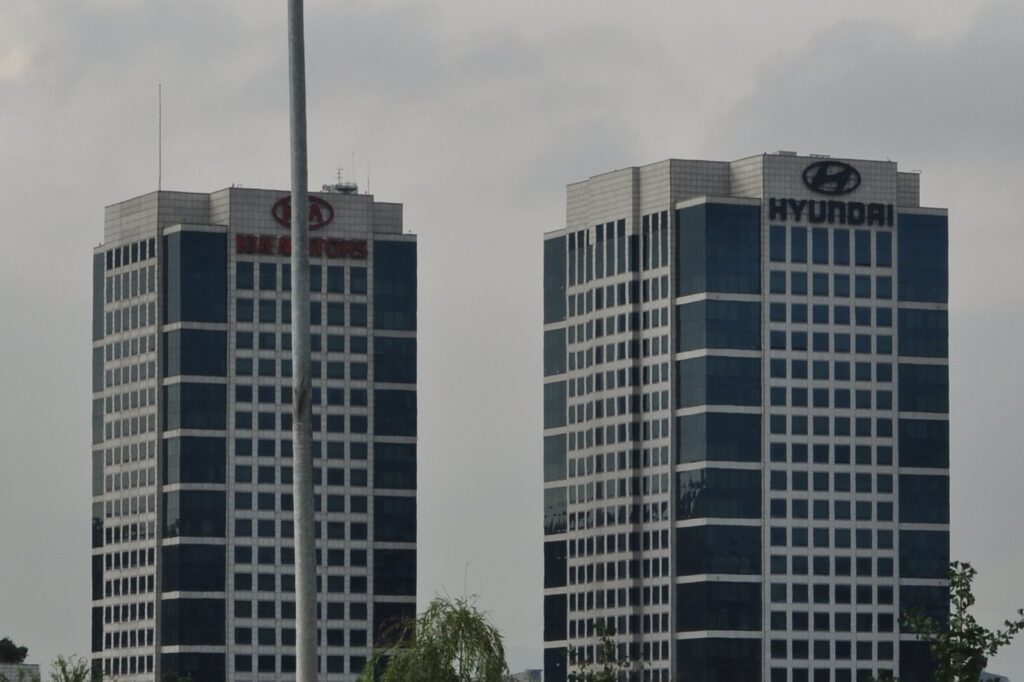
Photo: HappyMidnight (CC BY-SA 3.0)




