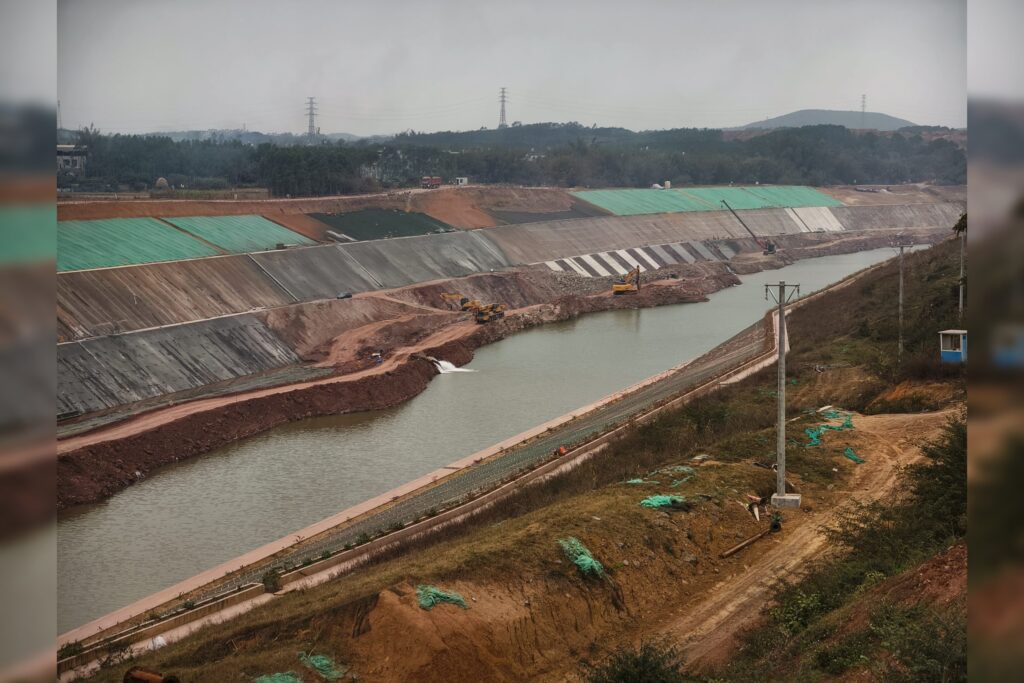
A 134-kilometre waterway now cuts through Guangxi, and China opened it on 16 September 2026. The Pinglu Canal, also known as the Pingtang-Luwu Canal, runs from the Xijin reservoir on the Yu river in Hengzhou down to the lower Qin River.
Until now, inland Guangxi had to reach the sea through the Pearl River delta in neighbouring Guangdong. The canal gives it a direct line to the Gulf of Tonkin and shortens the route by as much as 560 kilometres. It is the first river-to-sea canal built since the founding of the People’s Republic of China.
Locks and ships
The engineering is about climbing. Over its length the canal handles a 65-metre difference in elevation. Three lock complexes, at Madao, Qishi and Qingnian, each hold two locks 300 metres long and 34 metres wide. The Madao locks lift ships 30 metres, and they cut water use by 63% by partly discharging into nearby reservoirs.
The canal is rated as a class I waterway and designed for 5,000-tonne ships, 90 metres long with a 15.8-metre beam and a 5-metre draft. Building it meant excavating an expected 339 million cubic metres of material, which was used to create or reclaim 835.7 hectares of land.
The bill came to 72.7 billion yuan, about $10.2 billion.