
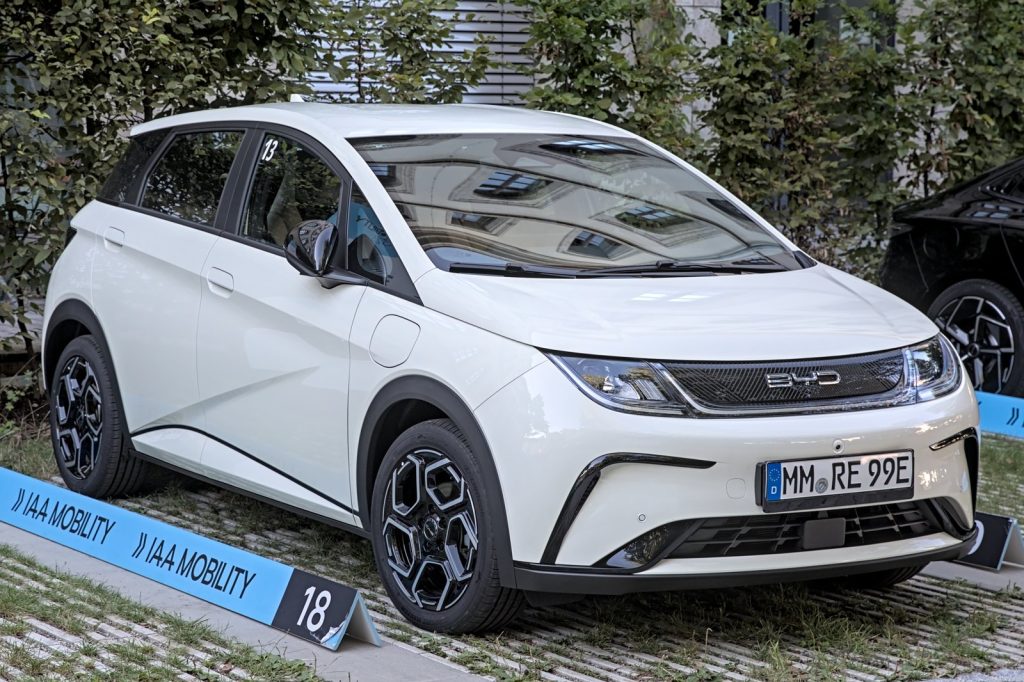
SHENZHEN, July 17 — One of the more intriguing industrial transformations of the past three decades started not with a car engine, but with a rechargeable battery for a mobile phone. BYD, the Chinese company whose name stands for Build Your Dreams, began life in 1995 when chemist Wang Chuanfu founded it in Shenzhen. The company spent its first eight years making batteries for the mobile phone industry before making a decisive and unexpected pivot into automobiles in 2003.
That move came through the acquisition of the state-owned Xi’an Qinchuan Automobile Company. Two years later, BYD launched its first car, the BYD F3.
It was a conventional petrol vehicle, but the company’s ambitions clearly ran beyond internal combustion. In 2008, BYD introduced the F3DM plug-in hybrid, which the company claims as the world’s first mass-produced plug-in hybrid electric vehicle. The science behind it was straightforward: a petrol engine paired with a rechargeable battery, giving drivers electric range without the range anxiety of a pure EV.
Partnerships and the Blade Battery
BYD’s electric vehicle push accelerated in 2010 when it formed a joint venture with Daimler AG, the German automotive giant, to create Denza, a premium electric vehicle brand. That partnership gave BYD access to Daimler’s engineering expertise while allowing the Chinese company to continue developing its own battery technology. The real breakthrough came in 2020 with the introduction of the Blade Battery.
This is a lithium iron phosphate, or LFP, battery that BYD engineers redesigned for improved safety and higher energy density. How it works: instead of the typical cylindrical or prismatic cells arranged in modules, the Blade Battery uses long, thin cells that are stacked directly into the battery pack, eliminating intermediate modules.
This allows more cells to fit in the same space while also improving heat dissipation. The result is a battery that resists thermal runaway far better than conventional lithium-ion packs, a key safety advantage that helped BYD sell the technology to other automakers.
Rapid Growth and Global Scale
By 2022, BYD had become the world’s largest electric vehicle manufacturer, surpassing Tesla in sales volume. That year, the company sold 1.86 million new energy vehicles — a category that includes both pure EVs and plug-in hybrids. The numbers grew even larger in 2023, when BYD sold 3.02 million vehicles.
Of those, 1.57 million were pure electric cars and 1.45 million were plug-in hybrids. The company’s product lineup expanded rapidly during this period.
Key models include the BYD Atto 3, launched in 2022; the BYD Seal, launched in 2023; and the Yangwang U8, a luxury SUV that also debuted in 2023. BYD also manufactures electric buses, electric trucks, and monorail systems, making it a broader transportation company rather than just a carmaker. BYD’s market capitalisation reached $100 billion in 2024.
The company now operates 30 industrial parks around the world and employs roughly 700,000 people. It has become a major force in the global EV market, exporting vehicles to Europe, Southeast Asia, and Latin America.
What to Watch
The key question for BYD going forward is how it manages its global expansion amid rising trade tensions. The United States and the European Union have both imposed tariffs on Chinese-made EVs, arguing that Chinese manufacturers benefit from state subsidies that give them an unfair advantage. BYD has responded by building factories outside China, including in Thailand, Brazil, and Hungary, to bypass tariffs and serve local markets directly.
The company’s vertical integration — it makes its own batteries, semiconductors, and most other key components — gives it a cost advantage that rivals struggle to match. How that plays out in markets that are increasingly wary of Chinese technology will determine whether BYD can sustain its growth trajectory beyond 2026.




