GUANGZHOU, November 27, 2026 — XPeng has unveiled WorldGPT, a single foundation model designed to learn from six machine types and distill that knowledge to edge devices running on cars, robots and drones. The company says the approach could cut the volume of fresh training data needed each time it adds a new machine to its lineup.
One Model, Six Machine Types
Announced on November 24 from Guangzhou, WorldGPT is part of XPeng’s Turing World Model family. The physical AI model is designed to learn from cars, boats, drones, single-arm robots, dual-arm robots and humanoid robots, combining visual understanding, reasoning, prediction and action planning in one system, according to the company.
The architecture uses camera images as a common learning interface. A car and a robotic arm have different controls, but both need to understand distances, recognise objects and anticipate movement. XPeng trains one large model in the cloud on data from the different machines, then distills it to smaller models that run directly on each device.
Cloud-to-Edge Distillation
The distillation step is where the practical payoff lies. XPeng says the approach could reduce the amount of new training data developers need when adding a machine type. For a vehicle owner, that could mean autonomous features that improve faster because the car benefits from what the fleet — and eventually robots and drones — have already learned, without each new model starting from scratch.
Project demonstrations start with about one second of real camera footage. WorldGPT then generates the next few seconds of video and overlays its planned movements, showing the prediction alongside the actual recording for comparison.
Parallel With Nvidia GR00T 2
The video-generation-and-action-planning approach parallels Nvidia’s GR00T 2 robot training model, which learns from footage of people and robots performing tasks. Analysts note the convergence signals an industry trend toward physical AI — models that do not just process data but generate actions in the real world.
From Architecture to Showroom
WorldGPT sits inside XPeng’s Turing Physical AI Architecture (VLA 3.0), unveiled November 25 at the eighth XPENG AI Day in Guangzhou. The architecture connects three systems: an ultra-fast layer that integrates body control into the AI loop, a real-time response layer powered by VLA 2.0, and a higher-level cognition layer for task planning and coordination.
The company describes itself as a global physical AI company with a full-stack architecture spanning Turing AI chips, world foundation models, and integrated software and hardware. Its product portfolio includes smart EVs, robotaxis and humanoid robots.
IRON Humanoid and Robotaxi Timeline
The first hardware to test the shared stack will be the IRON humanoid robot. IRON is scheduled to begin training as a store assistant in XPeng retail stores in Q1 2027, with public release targeted for Q2 2027. A purpose-built Robotaxi model, YOYO-01, is slated for release in 2027.
What Owners See Today
Current XPeng drivers are already using VLA 2.0. A CleanTechnica reporter testing a P7 with NGP VLA 2.0 in Guangzhou noted improved perception, smoothness and efficiency in dense urban traffic. The same reporter described the YoYo Robotaxi ride as a step up in comfort, with extremely smooth driving in congested conditions.
In Europe, the L03 (Mona L03) is priced at roughly $40,700 in Germany, undercutting the Tesla Model Y by about $3,500 and featuring integrated Google Maps — a first for a Chinese car brand.
Analyst View
Analyst fair value estimates for XPeng have shifted from US$18.03 to US$15.74, a reduction of about 13 percent, reflecting a split between those highlighting product momentum and cost improvement and those focused on execution risks, competition and sector headwinds.
Sources
- XPENG WorldGPT AI for Cars, Robots, and Drones
- __symbol__ Stock Quote Price and Forecast | CNN
- Happy Thanksgiving From Guangzhou, Visiting XPENG – CleanTechnica
- The Xpeng L03 Aims To Take On Europe And Undercut Tesla
- XPeng (NYSE:XPEV) Stock Sees Fair Value Cut As Analysts Weigh Growth Against Risks
- XPENG Unveils Turing Physical AI Architecture and IRON Robot
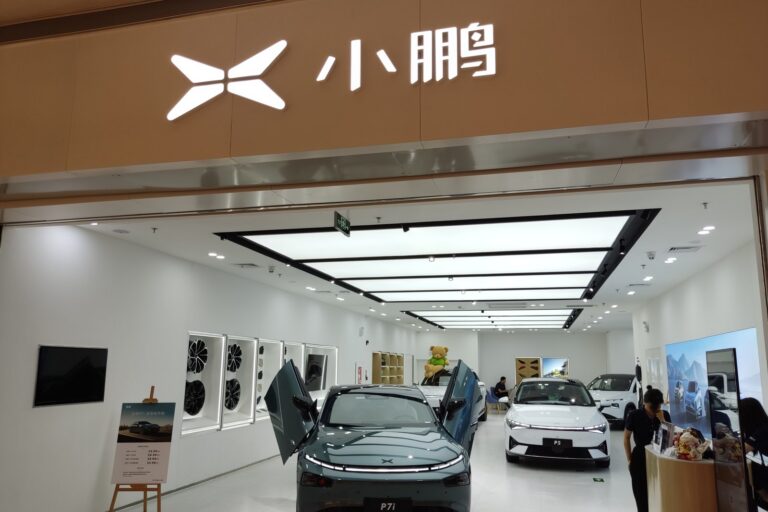
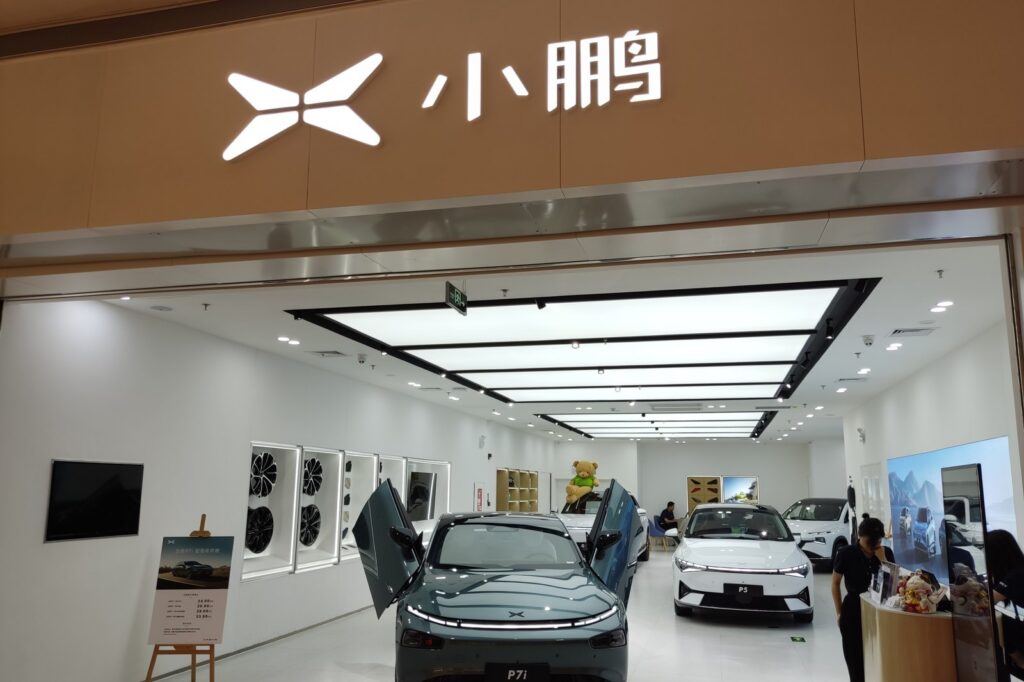
Photo: Mintzeqlaz 0519 (CC BY-SA 4.0)