
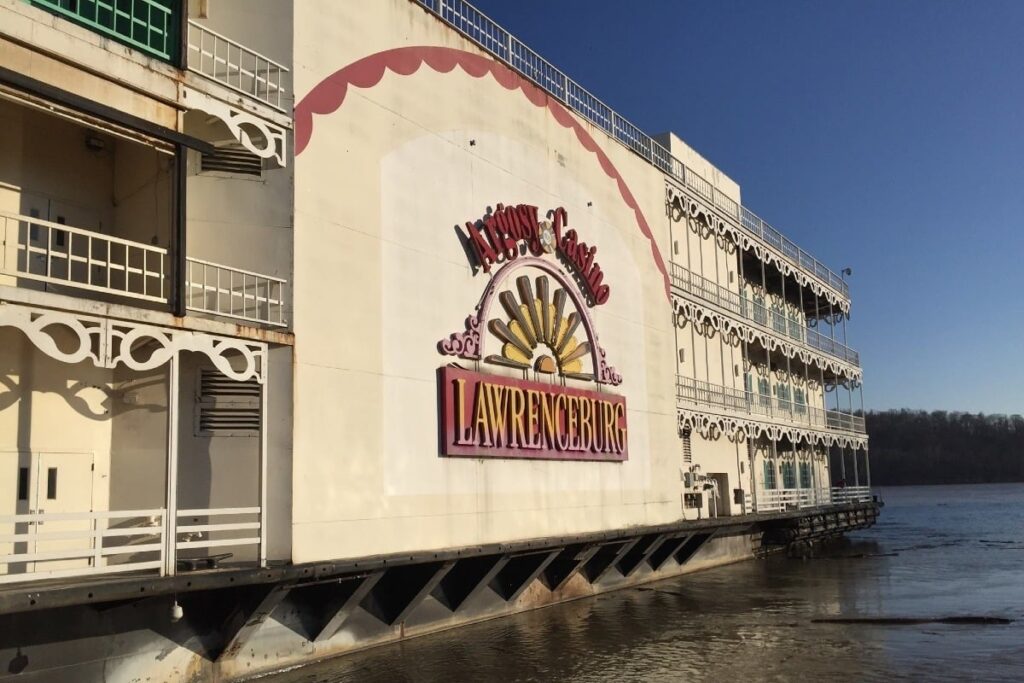
A 408-foot vessel that once dominated the Ohio River as the self-proclaimed “world’s largest riverboat casino” now rests on the floor of the Gulf of Mexico. The Argosy VI, which operated out of Lawrenceburg, Indiana, for years before closing in 2009, was intentionally sunk on July 1 as part of Alabama’s artificial reef system.
Video footage of the controlled operation shows the four-level boat slowly taking on water and disappearing beneath the surface.
A Landmark’s Final Journey
At its peak, the Argosy VI was a floating entertainment hub capable of holding up to 4,407 passengers and outfitted with more than 1,700 slot machines. But for communities across the Ohio River valley, the vessel represented far more than gambling.
It served as a gathering place where families celebrated milestones and visitors from throughout the region came for shows, dining, and events. Watching it sink into Gulf waters marks the close of an era for those who remember its heyday. The sinking was carried out by the Alabama Department of Conservation and Natural Resources, which has experience turning retired vessels into marine habitat. The department previously sank a retired 271-foot coastal freighter in 2013 and a 250-foot former research vessel in 2018.
Each addition to the artificial reef system creates new underwater structure that attracts marine life, slowly transforming into coral-covered habitat for generations of sea creatures.
New Life Under the Gulf
For people closer to the Gulf Coast — including Filipino communities working in regional fisheries and tourism industries — the artificial reef brings tangible benefits. Attracting fish supports local fishing families and the small businesses that depend on healthy waters.
The Argosy VI now serves a different purpose than it once did, becoming part of the Gulf’s underwater landscape and contributing to the region’s ecological and economic vitality. Riverboat casinos emerged in the late 20th century as a way for U.S. states to expand legal gambling while navigating regulatory restrictions that often limited such activity to navigable waters. Indiana legalized riverboat gambling in the early 1990s, and the Argosy VI became one of the most prominent and recognizable symbols of that era in the Greater Cincinnati region.
These floating casinos were designed as mobile entertainment venues, often featuring multiple decks with gaming floors, restaurants, and event spaces. The Argosy VI, in particular, stood out as one of the earliest and most iconic vessels in the area, drawing visitors from across the Ohio River valley and creating jobs in Lawrenceburg and surrounding communities.
A Shift in Purpose
The rise of riverboat casinos reflected a broader U.S. trend where states sought new revenue streams through controlled gambling expansions. For communities along major rivers like the Ohio and Mississippi, these boats became economic engines. The Argosy VI operated until 2009, after which it sat idle before being acquired by Alabama for its reef program.
Today, the sinking of the Argosy VI as an artificial reef highlights the shifting lifecycle of such structures. Once a hub of activity and commerce, its transformation into a marine habitat underscores how former industrial and commercial assets can find new purpose in environmental conservation.
For those who once visited or worked on the vessel, the change marks the close of a social and economic chapter tied to the region’s history. The vessel that once hosted thousands now silently fosters new marine ecosystems, a final voyage from the Ohio River to the depths of the Gulf of Mexico.




