
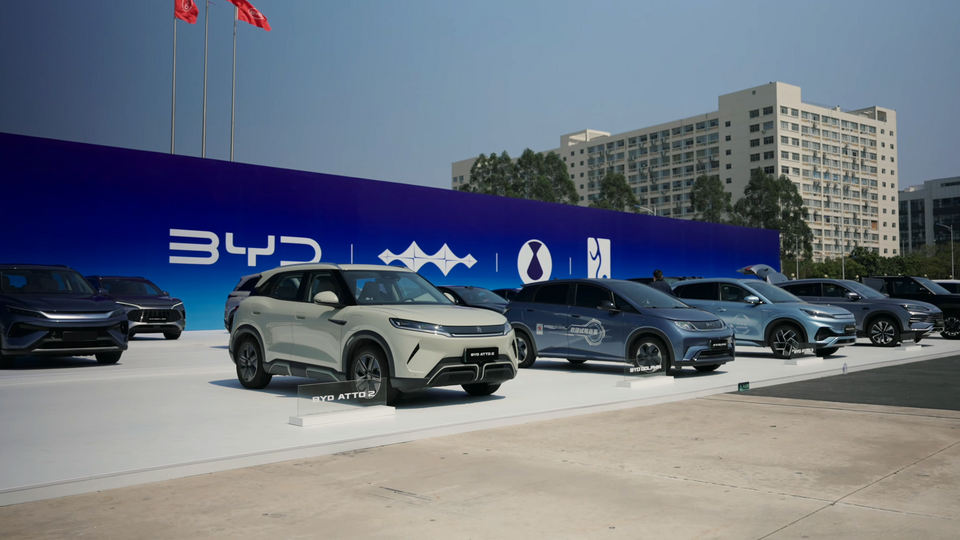
“The guy at BYD is better at actually making things than Elon is.” Charlie Munger, the late Berkshire Hathaway vice chairman, said that on the podcast Acquired in an episode released in October 2023. He called Wang Chuanfu a genius and a fanatical engineer, and said Wang had kept the company from going broke by working 70-hour weeks.
By the end of that year the numbers backed him up. Its 2023 sales topped 3.02 million new energy vehicles, which Chinese reporting says made it first in the world; roughly one of every five such vehicles sold globally carried its badge. Bloomberg reported in December that the company was poised to pass Tesla in fully electric vehicle sales, probably within the quarter.
From Wuwei to Shenzhen
Wang, then 57, was one of eight children, the second youngest, raised in poverty in the village of Wuwei in Anhui province. His parents died while he was a teenager, and his older siblings paid for his schooling. In his early career he worked in Beijing as a mid-level government researcher on rare-earth metals used in batteries and consumer electronics. A friend lent him almost $300,000, and in 1995 he started BYD in Shenzhen. Bloomberg’s index put his wealth at $14.8 billion.
BYD began with batteries. In the early 2000s it became the first Chinese supplier of lithium-ion cells to Motorola and Nokia. In 2003 it bought a failing state-owned car company. Its first plug-in hybrid, the F3DM, arrived in 2008, and sold 48 units in its first year. A New York Times reviewer likened its looks to a Y2K-era Corolla.
Timing then helped. China began subsidizing plug-in cars around then, with tax breaks for buyers, production incentives, research help, and cheap land and loans. BYD, a rare carmaker that also built its own batteries, was unusually well placed to use them.
Backers, rivals and the next test
Warren Buffett’s Berkshire Hathaway paid about $230 million in 2008 for almost 10% of the company. When Berkshire began trimming its holding in 2022, with shares near a record, the stake was worth about $8 billion, roughly 35 times the outlay.
Wang is not a showman. Bloomberg described him as someone who avoids social media and the limelight, though in one unusually forceful speech he said the time had come for Chinese brands to “demolish the old legends” of the auto world. Asked in March 2023 whether BYD wanted to be as big as Toyota, he gave a cautious answer: “BYD in China’s electrification is the winner for now, but how it will go tomorrow, we can’t say for sure.”
Tesla still led on revenue, income and market value at the end of 2023. Analysts at Bernstein projected Tesla would reach $114 billion in sales the following year against BYD’s $112 billion. Yuqian Ding of HSBC Qianhai Securities warned that reaching first place changes the job: “You’re going to have to find a way to beat yourself.”
Sources
- Chinese carmaker to overtake Tesla as world's most popular EV maker (Bloomberg, via CNBC-TV18)
- Why Warren Buffett-Backed BYD Becomes a "New" Success (IOL / Xin Gong)




