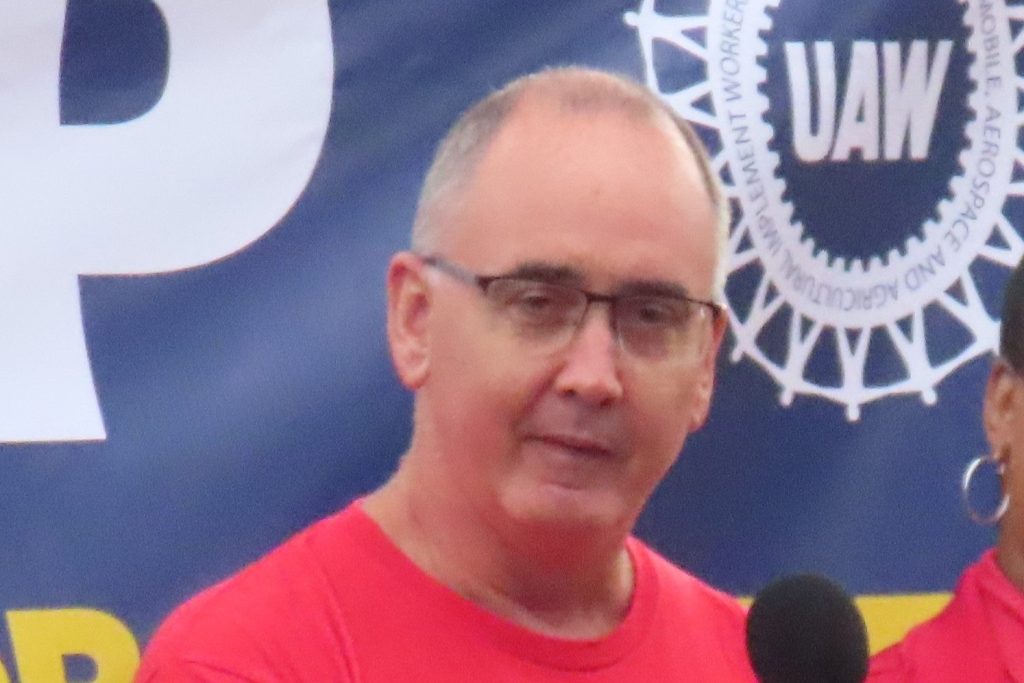
“This is our generation’s defining moment,” UAW president Shawn Fain told members in a Facebook Live event on Thursday night. A few hours later, the contract deadline passed with no deal, and the union walked out.
It is the first time the United Auto Workers has struck General Motors, Ford and Stellantis at the same time. The union did not call everyone out. Workers at three Midwest plants went first: a GM assembly plant in Wentzville, Missouri, a Stellantis plant in Toledo, Ohio, and part of a Ford facility in Wayne, Michigan. That is just under 13,000 people, less than 9% of the union’s roughly 150,000 members at the three companies.
A “stand up” strike
Fain calls the approach a “stand up strike.” More plants can be added at a moment’s notice, which keeps the automakers guessing where production will stop next. Plants not called out keep working without a contract. Fain has not ruled out a full walkout.
The tactic breaks with how the UAW usually operates. In the past it picked one company, pressed it until a deal emerged, and then pushed the other two to match. This time it bargained with all three at once.
What the union wants
Pay is the sticking point. The union is seeking a general raise of more than 40% over four years, which Fain says is in line with what CEOs have received. It also wants cost-of-living adjustments, restored pensions for new hires, higher pension benefits for current retirees and permanent status for temporary workers. Fox Business reported that full-time assembly workers at Ford and GM earn $32.32 an hour, while part-timers make about $17.
The automakers have moved. Opening offers of 9 or 10% have grown to as much as 20%. GM made a last offer on Thursday afternoon that GM CEO Mary Barra called a “compelling and unprecedented economic package.” The union says the cost-of-living protections on the table would not keep up with inflation over the next four and a half years.
Ford CEO Jim Farley told CNBC that meeting the union’s demands would have bankrupted the company. “If we signed up for the UAW’s requests … we would’ve lost $15 billion and gone bankrupt by now,” he said.
Fain pointed to profits that rose 65% over four years while worker pay rose 6%. GM chief Mary Barra, the best-paid chief executive of the three, made nearly $29 million in 2022, which SEC filings put at 362 times the pay of the median GM employee. Asked about it on CNN, Barra pointed to the profit sharing and healthcare in GM’s proposal.
On the picket line
Carrie Bellestri has worked the line at the Ford plant in Michigan for 29 years. News of the strike shocked her. “At first I was kind of scared, then reality hit. But we do deserve what we deserve,” she said. “I work my butt off every day, and I don’t make enough money to do it, to support my family.”
Brandon Bell, who works the engine line at the same plant, joined the picket line the moment the strike started at midnight. Many workers still feel the concessions the union made during the 2008 financial crisis. “We just want the wages that they gave up during the recession of ’08,” he said. “We’re tired of giving. We want to receive this time.”
President Biden, who had said little before the deadline, voiced support for the union on Friday and said he was sending acting Labor Secretary Julie Su and economic adviser Gene Sperling to Detroit. He said record auto profits “have not been shared fairly” with the workers.
Cost and leverage
The Anderson Economic Group estimated that a 10-day stoppage could cost the U.S. economy about $5.6 billion. Some labor experts doubt autoworkers hold the same cards as UPS drivers or airline pilots, who won raises of 48% and more than 46% this year. Toyota and Volkswagen are not facing strikes and keep building cars. “They don’t have exceptional leverage because there’s a lot of competition,” said Harry Katz, a collective bargaining professor at Cornell University.
Any deal still needs a ratification vote from members, who can send their leaders back to the table.
Sources
- The UAW launches a historic strike against all Big 3 automakers
- UAW strikes at GM, Ford, Stellantis plants after no new contract reached
Sources
- The UAW launches a historic strike against all Big 3 automakers : NPR
- UAW strikes at GM, Ford, Stellantis plants after no… | Fox Business