
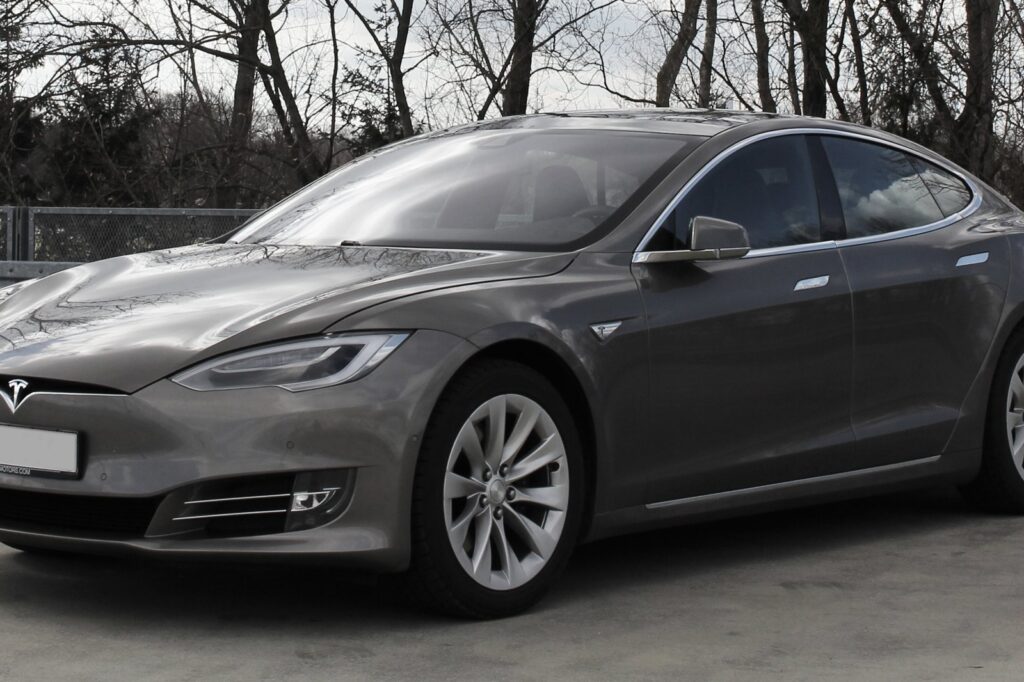
Tesla’s Model S and Model X Drive Luxury EV Sales Above $100,000
Tesla’s High-End Model Performance in Luxury EV Market
Tesla designs, manufactures, and sells battery electric vehicles including the Model S sedan and Model X SUV according to Tesla, Inc. The Model S sedan was introduced in 2012 and the Model X SUV in 2015 according to Tesla, Inc. The company’s strategy began with a premium sports car (Roadster) aimed at early adopters before moving to mainstream vehicles according to Tesla, Inc.
Pricing Strategy for Model S and Model X Above $100,000
Tesla led the battery electric vehicle market with a 17.6% share in 2024 according to Tesla, Inc. Tesla exceeded $1 trillion in market capitalization between November 2024 and February 2025, and again from May 2025 to July 2026 according to Tesla, Inc. Tesla’s stock closed at $378.03 on October 12, 2026, with a -1.22% daily move according to Yahoo Finance. Analysts expect Tesla to post earnings of $0.44 per share in its October 21, 2026 earnings report according to Yahoo Finance. Tesla’s Forward P/E ratio is 224.87, significantly above the industry average of 16.04 according to Yahoo Finance. The Zacks Consensus EPS estimate for Tesla decreased 14.2% over the last 30 days according to Yahoo Finance.
Comparison With Lucid and Mercedes-Benz EQS in Premium Segment
Tesla’s high-end models compete in the luxury EV space where pricing and positioning are key differentiators. While specific sales figures for Lucid and Mercedes-Benz EQS are not provided in the sources, Tesla’s Model S and Model X remain central to its premium offerings. The technical reality under the hood of these vehicles reflects Tesla’s long-standing focus on battery efficiency and software integration, as ever the detail that matters for informed readers.
Current Sales Trends and Market Share in Luxury EVs
Tesla’s overall EV market position benefits from its early entry and scale in the premium segment. The company exceeded $1 trillion in market capitalization again between November 2024 and February 2025, and from May 2025 to July 2026 according to Tesla, Inc. This valuation reflects investor confidence in Tesla’s ability to maintain leadership in high-margin EV sales. As of October 2026, analysts anticipate a year-over-year decline in earnings to $0.44 per share, though forward estimates still project annual growth according to Yahoo Finance.
Tesla’s Overall EV Market Position and Competitive Landscape
Tesla’s leadership in the battery electric vehicle market, with a 17.6% share in 2024, underscores its dominant position despite increasing competition in the premium segment. The company’s early entry into the EV space and continuous innovation in battery technology and software integration have enabled it to maintain a stronghold in high-margin luxury sales, particularly through the Model S and Model X lines.
While Tesla exceeded $1 trillion in market capitalization multiple times between 2024 and 2026, reflecting investor confidence in its long-term growth, the company has faced challenges including a decline in its status as the world’s leading EV manufacturer by the end of 2025. This shift highlights evolving market dynamics as legacy automakers and new entrants expand their EV offerings, intensifying competition across both premium and mainstream segments.
Tesla’s strategic focus on premium vehicles like the Model S and Model X has allowed it to capitalize on high-margin sales, supporting its financial performance even amid broader market pressures. The integration of over-the-air software updates, advanced driver-assistance systems, and a proprietary Supercharger network continues to differentiate its offerings in the luxury EV space, reinforcing customer loyalty and brand strength.
Future Outlook for High-End Tesla Models
Tesla’s Model S and Model X are expected to maintain their relevance in the luxury EV segment through continued software enhancements and over-the-air updates, which have historically extended vehicle functionality and user experience long after purchase. These capabilities reinforce Tesla’s differentiation in the premium market, where technological advancement is a key purchasing factor.
Despite increasing competition from legacy automakers and new EV entrants, Tesla’s early integration of battery efficiency, proprietary Supercharger access, and advanced driver-assistance systems positions its high-end models to retain appeal among consumers prioritizing performance, range, and charging convenience. The Model S and X continue to benefit from Tesla’s vertically integrated approach to hardware and software development.
The company’s ongoing investment in full self-driving software and next-generation battery cells may support future iterations of these models, even as market dynamics shift toward broader EV adoption.
Tesla’s Founding and Early Leadership
Tesla, Inc. was incorporated on July 1, 2003, by Martin Eberhard and Marc Tarpenning, who sought to create a car manufacturer that also functioned as a technology company. Elon Musk joined the company in February 2004 after leading its first funding round and became chairman of the board, later assuming the role of CEO in 2008. J. B. Straubel joined as chief technical officer in May 2004, contributing to the development of Tesla’s core technologies in battery systems, software, and electric motors.
Although Eberhard and Tarpenning left the company in January 2008, a 2009 lawsuit settlement allowed all five individuals—Eberhard, Tarpenning, Ian Wright, Musk, and Straubel—to be recognized as co-founders. This early leadership team established Tesla’s initial strategy of launching with a premium sports car, the Roadster, to target early adopters before expanding into mainstream electric vehicles.
Sources
Photo: Peteratkins (CC BY-SA 4.0)




