
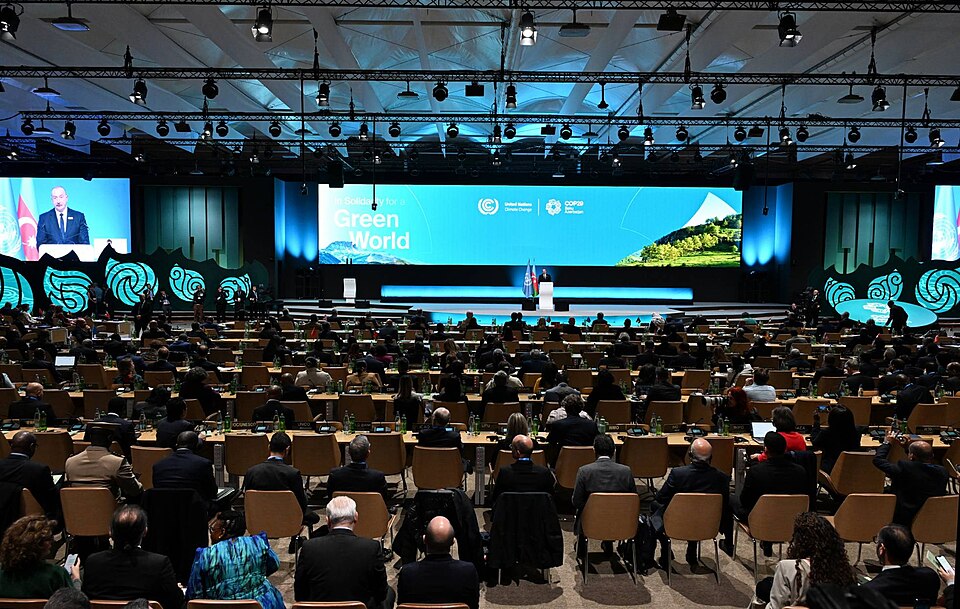
The financial bill for a warming world is already being counted in billions. Yvonne Aki-Sawyerr, mayor of Freetown, Sierra Leone, told the UN General Assembly that damage in Africa alone could top USD 20 billion, with similar losses expected in other highly exposed regions.
Her warning was one of many at the United Nations 2026 Climate Summit, held on September 23 during the High-Level Week of the 81st General Assembly session. Climate experts say it is now virtually inevitable that global temperatures will pass 1.5°C above pre-industrial levels within ten years, nearly a decade after the Paris Agreement was adopted. That overshoot brings extreme weather, public health emergencies and damage to infrastructure, particularly in low-lying coastal areas.
Guterres on fossil fuels
UN Secretary-General António Guterres opened the summit with a blunt assessment. Emissions are still rising when they must plummet, he said, and continued fossil fuel expansion defies “science, economics, and common sense.” He pointed to households squeezed and budgets drained by fossil fuel dependence while producers book windfall profits. Doubling down on oil and gas, he said, will lock in vulnerability for decades.
Coasts, fisheries and a Pacific storm
Prime Minister Tarique Rahman of Bangladesh told delegates that up to 18 percent of his country’s coastal land could end up underwater, putting tens of millions of people at risk. Fiji’s President Naiqama Lalabalavu said more than half of his country’s people live within a kilometer of the shore, and that the fish available per person is projected to fall by almost 25 percent by 2050, a direct threat to food supplies.
Celeste Saulo, head of the World Meteorological Organization, said the world had just lived through its hottest July and August on record, with sea surface temperatures at a record high. She cautioned that several tipping points could be crossed.
Speakers also dwelt on a “Super El Niño” forming in the Pacific. The WMO has described it as potentially the strongest in at least a millennium. Data from NOAA’s Climate Prediction Center put the chance at 90 percent that it becomes one of the most extreme weather events of the 2026-2027 winter. Saulo said its effects would be massive and long-lasting and would make 2026 the hottest year on record.
Money and pledges
Michael Bloomberg, the Secretary-General’s Special Envoy on Climate Ambition and Solutions, said international funding falls short and that the gaps can mean the difference between life and death. Climate finance reaching developing countries has more than doubled since the Paris Agreement took effect, he noted, but “that’s not enough.”
The summit set three goals: bring temperatures back below 1.5°C as fast as possible, limit how severe and how long the overshoot lasts, and speed up the shift to renewable energy. The pathways highlighted were closer cooperation between governments, steady investment in adaptation and resilience monitoring, and wider rollout of renewables. These have grown considerably cheaper than coal, oil and gas, and could avert hundreds of billions of dollars in climate losses.
Countries accounting for roughly 90 percent of global emissions have filed updated national climate pledges. Those pledges are still projected to fall short of what is needed to prevent the overshoot.




