The money that built Toyota came from a loom. In December 1929, Kiichiro Toyoda signed a deal in England selling the patent rights of his father’s Type G automatic loom to Platt Brothers of Oldham, then the world’s largest maker of textile machinery. The price was first set at 100,000 British pounds. After a renegotiation, caused by the global downturn, the final payment was 83,500 pounds. That sum became the seed capital for a car company.
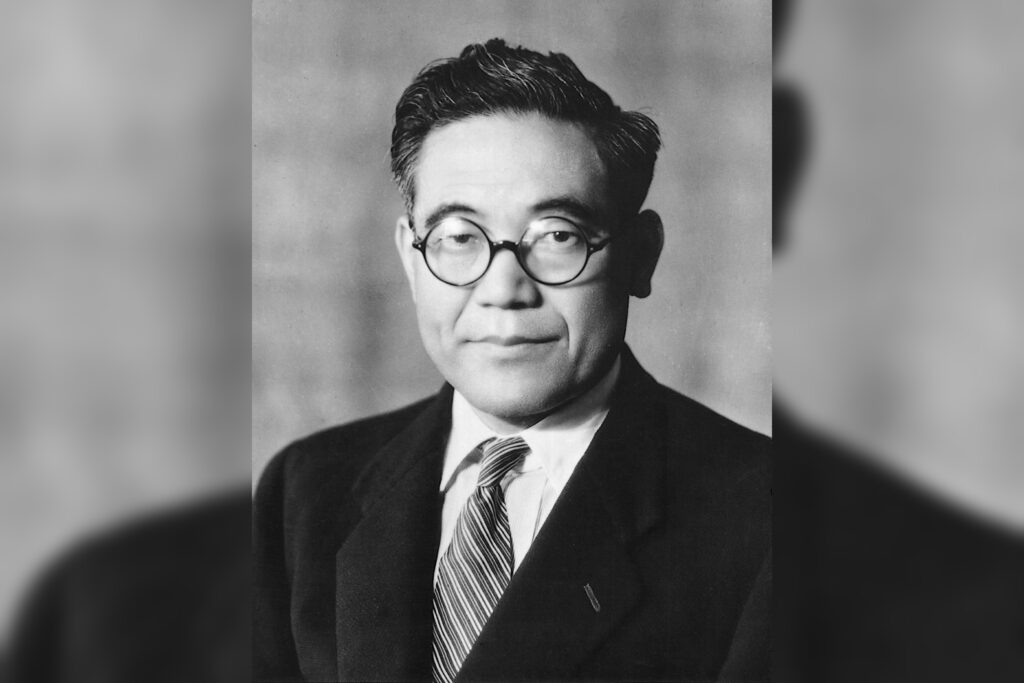
Kiichiro was born on June 11, 1894, in Yamaguchi village in Shizuoka Prefecture, the eldest son of Sakichi Toyoda, the inventor people nicknamed “Japan’s Thomas Edison.” He grew up in factory housing, around machines. Unlike his self-taught father, he went to university, graduating from the mechanical engineering department of Tokyo Imperial University in 1920.
The conviction
Two experiences pushed him toward cars. On September 1, 1923, the Great Kanto Earthquake hit Tokyo while he was visiting a friend at the Ministry of Railways to talk about automobiles. The quake wrecked the railways, and automobiles proved critical in relief work. Later, his grandson Akio Toyoda said, the sight of so many cars on American city streets in the late 1920s amazed him and fixed his determination to build an automotive industry at home.
Exactly ten years after the quake, on September 1, 1933, he opened an automotive division inside Toyoda Automatic Loom Works. His team took apart a 1933 Chevrolet, sketching and measuring every piece, and he bought a 1934 DeSoto and a 1934 Chevrolet as design references. A prototype followed two years later.
Toyota is born
On August 28, 1937, Toyota Motor Co., Ltd. was officially registered as a spinoff. Risaburo Toyoda, Sakichi’s son-in-law, was president and Kiichiro was executive vice president. He took the top job in 1941. The name itself was a small decision: “Toyota” was reportedly seen as luckier than “Toyoda” and easier to write in Japanese characters.
The company’s first production car, the Toyoda AA, was built under his guidance. It was also where he first tried out waste-free production, including the just-in-time idea, which became one of the two pillars of the Toyota Production System. His rule was short: “Just make what is needed in time, but don’t make too much.” Years later his cousin Eiji Toyoda called Kiichiro’s factory design and process documents “The Roots of TPS.” The AA drew on foreign models too. The New York Times, quoted by History, called it “a blatant copy of (or an homage to) a Chevrolet sedan.”
1950
The postwar years were brutal. After the deflationary Dodge Line policy of 1949, dealers refused vehicle allocations, inventory piled up past 400 units, and Toyota ran a monthly deficit of roughly 22 million yen. On June 5, 1950, Kiichiro resigned as president, taking personal responsibility for the job cuts the crisis demanded. He chose to step down rather than ask workers to sacrifice while he stayed in charge.
He was reportedly preparing to return when he died of a cerebral hemorrhage on March 27, 1952, at the age of 57.
What followed
The company he left behind kept growing. The Corolla arrived in 1966 and by 1997 had become the world’s best-selling car, with more than 35 million sold. The Prius became the first mass-produced hybrid in 1997 in Japan. In 2008, Toyota sold 8.97 million vehicles against General Motors’ 8.35 million, taking a sales crown the American giant had held for more than 70 years.
The family stayed at the wheel. Kiichiro’s son Shoichiro became president in 1981, and his grandson Akio led the company from 2009 to 2023.
Sources
- Kiichiro Toyoda, founder of the Toyota Motor Corporation, dies – HISTORY.com
- Kiichiro Toyoda – TPS Encyclopedia – Art of Lean
- Toyota Motor Corporation Founder Kiichiro Toyoda Inducted into Automotive Hall of Fame – Toyota Global Newsroom