
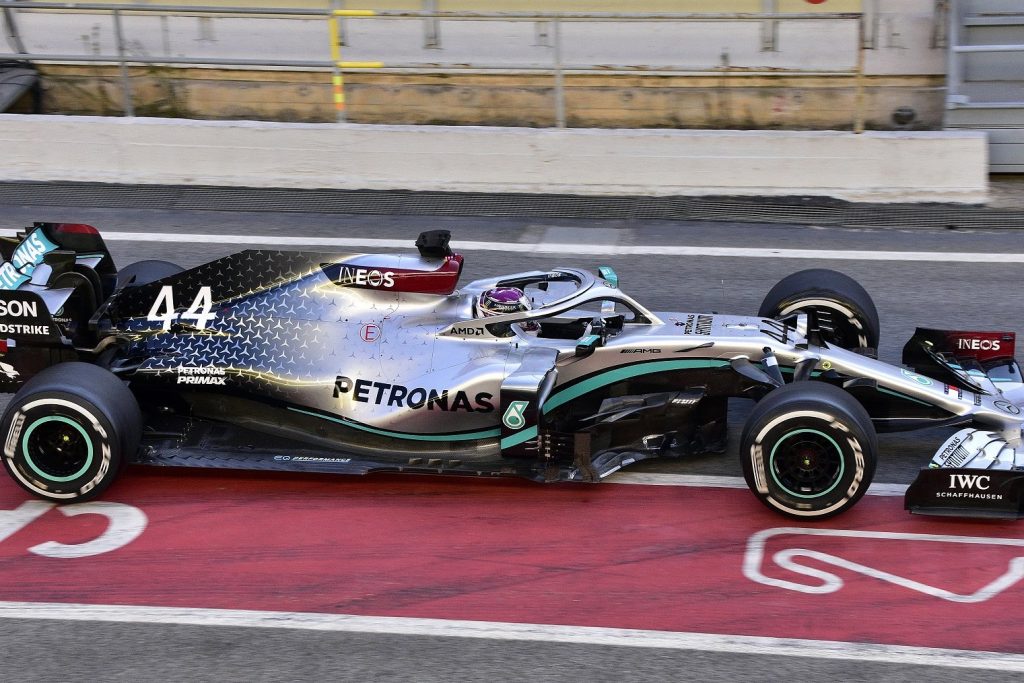
Under floodlights in the desert, in April 2014, Formula One gave itself the race it badly needed. Lewis Hamilton and Nico Rosberg took their Mercedes cars wheel to wheel for lap after lap in the Bahrain Grand Prix, trading the lead and crossing the line barely a second apart, and much of the sport agreed it had watched the best grand prix in a decade. Hamilton, then 29 and the winner, called it “a racer’s race,”, possibly the finest of his 24 victories, and few who followed the sport argued.
The timing mattered. The 2014 season was the first for Formula One’s new hybrid power units, and before Bahrain the reform looked close to failure.
The old cars had carried 750-horsepower naturally aspirated V8 engines. The replacement paired a 1.6-liter turbocharged V6 with two generator units, one harvesting energy from braking, the other from the exhaust, feeding an electric boost worth up to 30 percent of what the pistons alone produce. Total horsepower stayed close to V8 levels, under rules that also cut permitted fuel use by roughly 35 percent from the V8 years, a nod to the manufacturers who wanted racing technology tied to road cars.
The Rebellion Before the Race
Preseason testing had been a rolling embarrassment, with the Renault-powered Red Bulls sometimes managing only a handful of laps at a stretch, and there were genuine fears that few cars would even finish in Melbourne. Ferrari’s chairman, Luca di Montezemolo, warned of an era of “taxi cab driving.” “To have drivers who save fuel and tires, this is not Formula One,” he declared on arrival in Bahrain. Bernie Ecclestone, the commercial rights holder, forecast “boring” racing for a global television audience Formula One put at about 450 million, one that had already fallen by at least 20 percent during the old engine formula’s final years. Sebastian Vettel, champion in each of the previous four seasons, joined the contempt, aimed partly at the subdued growl that replaced the 18,000-r.p.m. scream.
Behind the scenes, a meeting put Ecclestone and di Montezemolo in a room with Jean Todt, the FIA president and a prime mover behind the hybrid switch. The circle later widened: Niki Lauda arrived from Mercedes, Christian Horner from Red Bull, Ron Dennis from McLaren. The talk was of using Todt’s powers to cut race distances, loosen the fuel limits and adjust the tires, an impasse between the haves and the have-nots. Lauda and Dennis held the line for keeping the 2014 rules as written.
The Answer on the Track
Bahrain then settled the argument for a weekend. Drivers passed and repassed one another all race; Sergio Perez’s Mercedes-powered Force India recorded the fastest straight-line speed at 204 m.p.h., 9 m.p.h. beyond the best any V8 had managed the year before. Hamilton’s win gave Mercedes its second consecutive one-two, after Malaysia a week earlier, its first such result since 1955. “Twinvincible!” the company trumpeted in full-page British newspaper advertisements the following Monday.
Ecclestone and di Montezemolo left for their jets before the chequered flag, granting a single concession: officials would work with teams on reworking the V6 exhaust for more noise, with engineering targeted at the tests following the Spanish Grand Prix, scheduled for May 11. “I think the noise matters,” conceded Lauda, a three-time champion. “It gets in our head that the more noise you get the quicker you go,” he added. “It’s an emotional thing.” Rivals, though, privately put Mercedes’ advantage as high as two seconds a lap, and nothing in Bahrain suggested the emotional debate would slow them.
Sources
- Formula One’s New-Age Hybrids Find Their Footing – NYTimes.com
- F1 Power Unit 2026 Explained: How It Works | Formula Dream




