As a boy in Lagos, Teslim Balogun had no football. So he tied a hard, unripe orange to a piece of string and juggled it from one foot to the other whenever he had a spare minute, even crossing the road. “I was a lad in Lagos long before I knew what the game was about, before I had even seen a football,” he later recalled.
That boy, born in 1927, became the man Nigerians called “Thunder” for the force of his shots. Adegboye Onigbinde, who twice coached the Super Eagles, told Punch in 2020 that “the greatest footballer Nigeria ever produced was Teslim Balogun, there’s no doubt about it.”
From Apapa to Railways
Balogun went to St. Patrick’s Primary School in Oke-Awo, Lagos, and St. Mary’s Catholic School in Port Harcourt. His father, Oseni, was an international cricketer. In 1945, aged 18, he played for the PWD second team and for Apapa Bombers, who won the second division that year. UAC and Lagos Marine followed. From 1948 to 1950 he led the line for the Railway Club, which took every championship trophy it contested, and he scored a hat-trick against Police Athletic.
He won the Challenge Cup five times in seven finals. In 1953 he became the first player to score a hat-trick in that competition’s final, according to Punch.
Barefoot in England
In 1949 Nigeria’s first national team, the UK Tourists, sailed from Lagos on the RMSS Apapa on 16 August and reached Liverpool 13 days later. Balogun was the star. The players arrived without boots. Their first match, against Marine Cosby, ended 5-2 to Nigeria. Before the next, against an Athenian League XI, the English side refused to play unless the Tourists wore boots. They did, and lost 8-0. A 2-2 draw with a Corinthians League XI is remembered as the best of the nine games. The tour finished with two wins, two draws and five defeats, all five defeats in boots, Vanguard recorded.
The Daily Graphic’s sports editor, Edgar Kail, was struck by the forward: “their 22 year old six foot three bow legged, giant centre forward, is a real artist and strange as it may seem in modern football, he holds the ball and uses it well.”
On the voyage home the team stopped at Freetown and beat Sierra Leone 2-0 on 8 October 1949, Nigeria’s first official match against another country.
Peterborough and QPR
Balogun asked Darby Allen, secretary of the Nigerian Football Association, for help finding an English club. Allen introduced him to Peterborough manager George Swindin, a former Arsenal goalkeeper, who gave him a trial and signed him. In 1955 he turned professional, the first Nigerian football export. He finished the season as top scorer for Peterborough’s reserves.
He also wanted to study printing, and enrolled at the London School of Printing. Working out at the Paddington Recreation Ground, he met a Queen’s Park Rangers supporter who told him to write to the club. Manager Jack Taylor invited him for a trial and accepted him. Balogun scored in his first match, against Watford. Over the 1956/57 season he scored three goals in 13 Football League appearances, Punch reported, after a spell at Skegness Town.
Coach, and a stadium
Balogun went home in 1961 and qualified as the first African professional coach. He managed Nigeria at the 1968 Olympics. Onigbinde called a goal Balogun scored at the Olubadan Stadium in 1968 the greatest he had ever seen.
He died in his sleep on 30 July 1972, aged 45, leaving eight children. His wife Mulikat, a table tennis player, remembered talking with him until about 2:30am that morning. A condolence letter arrived from the Queen of England.
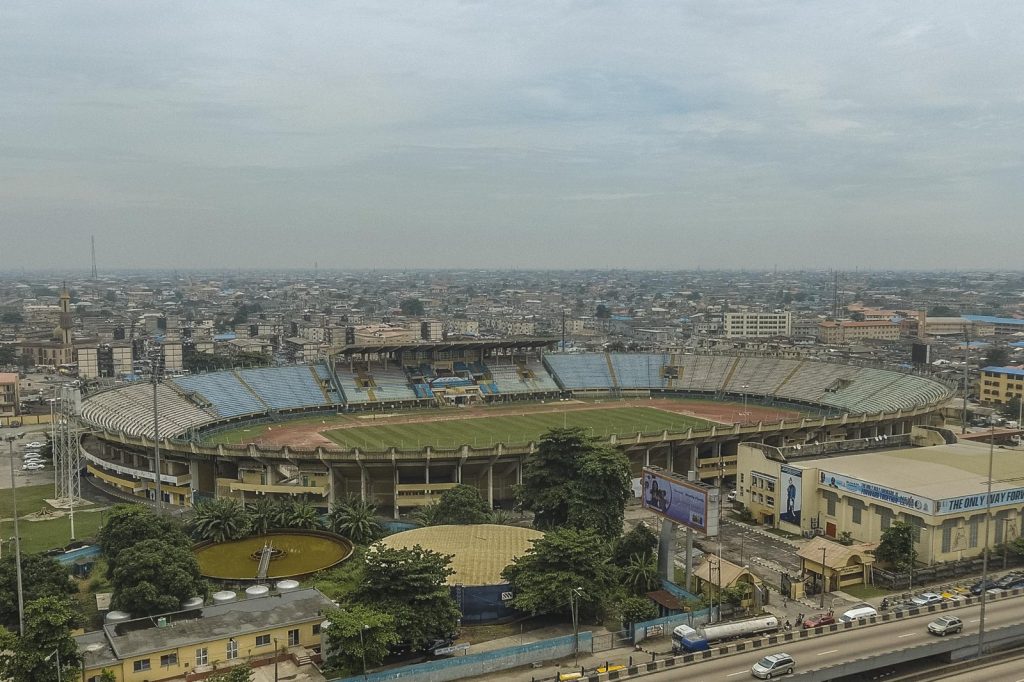
The Teslim Balogun Stadium in Surulere, Lagos, opened in 2007 under Governor Babatunde Raji Fashola, with room for 24, 325 people. Conceived in 1984, it stalled for about 23 years and was occupied by homeless people and area boys as recently as 2006. The Teslim Balogun Foundation, set up after his death, helps the families of former Nigerian internationals who have fallen into financial distress.
Sources
- Onigbinde: Balogun Nigeria's greatest footballer – Punch
- Teslim 'Thunder' Balogun: What Nigerians never knew about him, exploits home and abroad – Vanguard (contributed column by Femi Kehinde)