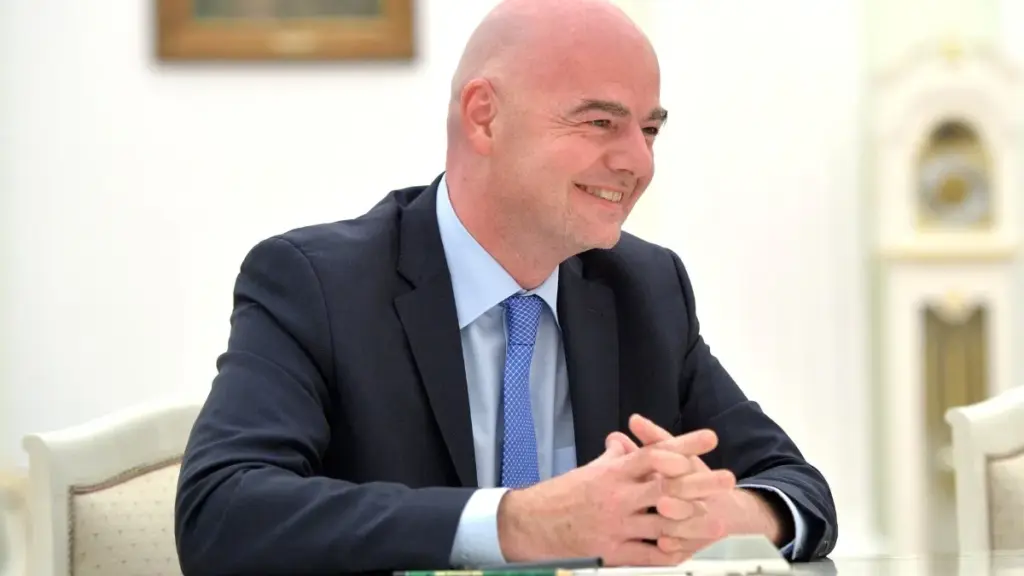
The first football club Gianni Infantino ever ran, he ran at 11. With two friends he took over FC Folgore, a team of Italian immigrants in Upper Valais, and entered it in the Swiss league’s fifth tier.
Born on 23 March 1970 in Brig, Switzerland, he is now the president of FIFA, and has been since 2016. His parents had come from Italy for work. His father, from Reggio Calabria, worked on the railway, including sleeping cars, and his mother, from the Val Camonica, ran a newsstand in Brig. Infantino has recalled growing up around the station and helping at the kiosk. He holds Swiss and Italian citizenship.
From the newsstand to UEFA
His father supported Inter Milan, and the first match Infantino saw as a child was Inter at San Siro. As a player he reached the Fourth League, the eighth tier of Swiss football. He studied law at the University of Fribourg, paying his way by cleaning railway vehicles and working sleeping cars. He qualified as a lawyer, specialised in sports law, and advised the Italian, Spanish and Swiss football leagues. In the late 1990s he became Secretary General of the International Centre for Sports Studies at the University of Neuchâtel.
He joined UEFA in August 2000. By January 2004 he was Director of its Legal Affairs and Club Licensing Division. He became Secretary General in October 2009, after stints as interim chief executive and Deputy General Secretary. During his time there UEFA introduced Financial Fair Play and expanded Euro 2016 to 24 teams, and he played a part in creating the Nations League. For years he also drew the Champions League, Europa League and European Championship, work he handed on after moving to FIFA.
The Panama Papers cast a shadow. They indicated that while senior legal official at UEFA, Infantino co-signed a television-rights contract with a company later linked to defendants in the US investigation into FIFA corruption. He said he was “dismayed” and had never personally dealt with the indicted parties.
FIFA, from 2016
On 26 February 2016 he was elected FIFA president on the second ballot, with 115 of 207 votes, to finish Sepp Blatter’s term. He was the first Italian in the job. He was re-elected unopposed on 5 June 2019 by all 211 member associations.
His list of changes is long. VAR arrived at the 2018 World Cup. The World Cup grows to 48 teams from 2026, the Club World Cup to 32 teams from 2025, and the Women’s World Cup went from 24 to 32 teams for 2023, with its prize money doubled. He has overseen three men’s World Cups: Russia in 2018, Qatar in 2022, and North America in 2026. In 2020 he joined the International Olympic Committee, elected by 63 votes to 13.
The record also has critics. FIFA’s ethics investigators examined whether he breached the code in July 2016 and found no violation. In Switzerland he was the subject of criminal proceedings over undisclosed meetings in 2016 and 2017 with Attorney General Michael Lauber. In May 2017 he dismissed the independent chairmen of the Ethics Committee, Cornel Borbély and Hans-Joachim Eckert, while they were reportedly investigating him. Documents leaked to Der Spiegel in November 2018 showed he intervened to rewrite the ethics code, limiting preliminary investigations and setting a 10-year limit on historical corruption cases.
At the 2019 Women’s World Cup, stadiums chanted “Equal pay!” over the prize money. Before the 2023 tournament he drew criticism again for telling women to “pick the right battles.” In June 2026, ten years after his election, Michel Platini filed a criminal complaint in France against FIFA and Infantino, alleging influence-peddling to keep him from succeeding Blatter.