
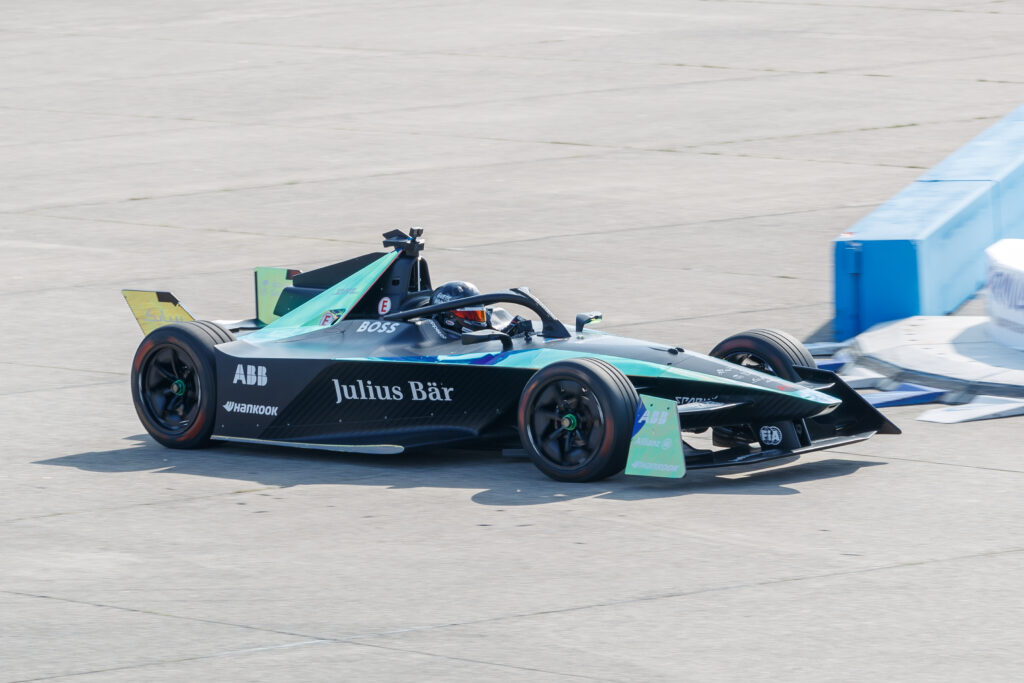
The Racing Lab Under the Bodywork
Under the hood, as ever, the story is transfer. When a CNET correspondent visited the season-opening Formula E E-Prix in São Paulo, Brazil, the grandstands buzzed in tropical heat and humidity while the circuit rang with a high-pitched electric whine rather than the roar of combustion. After meeting race team leaders and chief executive Jeff Dodds, he landed on the series’ core pitch: Formula E is “a technology test lab for the next EV you might buy”. The technical reality, pleasingly, backs the marketing.
Same Chassis, Different Brains
The rules force the ingenuity. Every team races a car built around one shared chassis and battery, and each manufacturer locks its own powertrain hardware in for a full generation, with no changes allowed mid-season once the spec is approved. Software becomes the main road to lap time, and teams can develop, test and ship updates within a single race weekend. Formula One works the opposite way: squads design nearly the whole car themselves, gains arrive through aerodynamic and mechanical updates, and software changes crawl through far longer validation cycles. Seven of ten Formula E teams are everyday road-car manufacturers, among them Porsche, Jaguar, Nissan, Mahindra, Cupra, Citroën and DS Penske, and everything learned flows toward the cars they sell the rest of us.
Cooling, Oil and the Cayenne
The detail that matters most is small and oily. Porsche’s racer, the 99X Electric, cools its motor with oil instead of the traditional water-based approach, letting the motor run cooler while working harder, for longer. Skip the oil and the motor would need to be “roughly one and a half times larger” to match the same performance. That exact concept now ships in the Cayenne Electric, which can be ordered today, where Porsche says it helps deliver up to 98% motor efficiency; most electric motors sit in the low-to-mid 90% range, and every step toward that ceiling is energy not lost as heat, which means performance and usable range. Porsche team principal Florian Modlinger noted in December that his squad can slip new code into the car overnight, something F1’s longer cycles simply do not allow.
Braking as a Power Source
Regenerative braking is the clearest crossover. A Formula E car can recover as much as 600 kilowatts while braking, no small feat for a machine weighing upwards of 850 kilograms, some 1,874 pounds. The electric motors do most of the slowing, so traditional brake pads are rarely used, and Porsche says the race car recovers more than half the energy it consumes during a race. The Cayenne Electric mirrors the racer with up to 600 kilowatts of peak regeneration, and Porsche reports that up to 97% of its braking events are handled electrically: smoother deceleration, better efficiency, far less brake wear.
Software, Heat and Habit
Jaguar once pushed an over-the-air update to the I-Pace that added roughly 20 miles of real-world range, work driven by its Formula E team’s data and calibration. At the São Paulo race the track surface climbed past 60 degrees Celsius, around 140 in Fahrenheit, hotter than simulations predicted, and the team rewrote chunks of its temperature strategy within hours so the car stayed safe; that adaptability now shapes how Jaguar calibrates production EVs for hot climates. DS Penske traces the one-pedal driving and intelligent regen features of its DS No. 8 back to race development, and its road-car logic for splitting power between front and rear motors shares DNA with racing software. Cupra team principal Gary Paffett, a former Formula One driver, frames the whole exercise as “recycling energy rather than throwing it away as heat”, a mindset Cupra’s upcoming US-market EVs lean on heavily. The detail that ends the argument comes from Nissan’s Tommaso Volpe: his cars begin races carrying only about 15% more energy than the distance demands, and everything else must be recovered through braking.
Sources
- Revolution in testing as new Porsche Formula E car pushes boundaries – Porsche Newsroom
- Formula E Is a Test Lab for Consumer EVs, Maybe Even the One You Drive – CNET




