
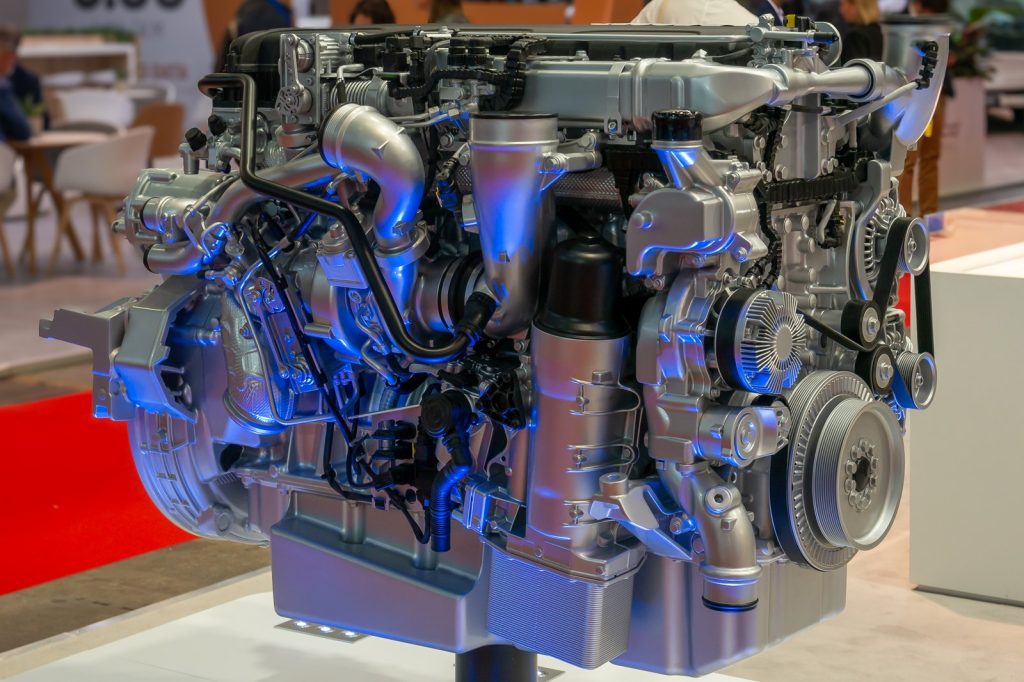
On 10 August 1893, in a workshop in Augsburg, Rudolf Diesel injected fuel into his first prototype engine for the first time. It burned, and the blast destroyed the instrument meant to measure it. The fuel that day was petrol.
Diesel’s idea, in plain terms, was to skip the spark. Think of a fire piston, the traditional fire starter he was shown as a student in 1878: squeeze air fast enough and it gets hot. A diesel engine does the same thing. It draws in air, compresses it in the cylinder until it is far hotter than the fuel’s ignition point, and then injects the fuel, which ignites on contact. That is why the engine is also called a compression-ignition engine, and why it needs no spark plug.
Why it wastes less
A diesel does not throttle its intake air. To change torque it simply injects more or less fuel, so it runs with a lot of spare air. That lean burn and a very high expansion ratio give it the highest thermal efficiency of any practical internal or external combustion engine. Large, low-speed diesels of the kind used in ships can reach effective efficiencies of up to 55%.
The first working engines were far more modest. Diesel’s test engine hit 16.6% in June 1895. On 17 February 1897, in the main test run by Moritz Schröter, a later prototype rated at 13.1 kW reached 26.2%. Steam engines of the time managed only 6 to 10% of the heat energy converted into work.
The road there was rough. Diesel’s 1893 essay drew heavy criticism because the cycle he first described could never do useful work, and by June 1893 he had dropped it for a constant-pressure cycle. Krupp even considered cancelling its contract after early problems. By 1898, though, Diesel was a millionaire.
Where diesels work today
Diesels began as a more efficient replacement for stationary steam engines. Ships and submarines took them up from the 1910s, then locomotives, buses, trucks and farm and heavy equipment. Some automakers started using them in cars in the 1930s, and the 1970s energy crisis pushed most major brands to offer a diesel model at some point. The largest diesels in service, 14-cylinder two-stroke marine engines, produce almost 100 MW each.
The trade-off is pollution. Air pollution and emissions are harder to control in diesels than in gasoline engines, which is why their use in the US is now mostly limited to larger on-road and off-road vehicles. More than 5,000 diesel aircraft engines were delivered worldwide between 2002 and 2018, mainly for light airplanes and unmanned aerial vehicles.
Engineers have also looked for a middle path. Homogeneous charge compression ignition mixes fuel and air evenly and compresses them until the whole charge ignites on its own. It aims for gasoline-like emissions with diesel-like efficiency, but the ignition timing is hard to control, and the engine has a narrow torque range.




