
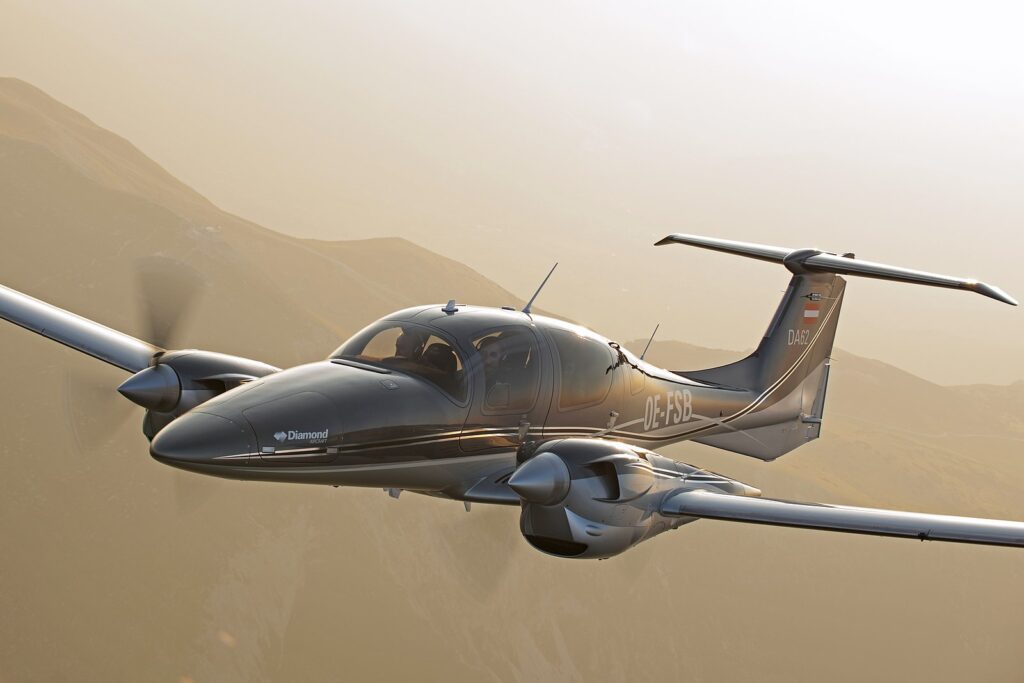
Eighteen gallons an hour. That is what Joe Casey of Twin & Turbine saw the DA62 burn in total, both engines combined, on a ferry flight from Austria to Florida. He and a colleague averaged 9 gph per engine and held cruise speeds of 180 to 185 KTAS the whole way. On the leg to Iceland the aircraft covered the distance in 2.3 hours on 40 gallons of Jet-A, cruising at 184 KTAS.
Numbers like that explain the Diamond DA62’s pitch: the safety of a second engine without the fuel bill that usually comes with it.
From DA52 to DA62
The airplane did not start out with its current name. Germany’s fliegermagazin, which ran a pilot report in July 2015, noted that it was first called the DA52, and the magazine covered the prototype in its August 2012 issue. As development went on, the gap to its smaller sibling, the DA42, kept widening, so Diamond jumped to a bigger model number. The outer wings come from the DA42, the landing gear is a strengthened version of the DA42’s, and the fuselage comes from the DA50. The engines are Austro Engine AE330 units, tuned to 180 horsepower.
EASA certification came at the AERO 2015 show, where Diamond also took its first orders: twelve bookings. Chief executive Christian Dries promised the first delivery in September and said the aim was “one machine a week.” US approval was then planned for the first quarter of 2016.
Why jet fuel matters
The fliegermagazin pilot compared the DA62 with the Beech Baron, which burns 130 litres of avgas an hour in cruise. At comparable power settings the DA62 flew only about ten percent slower, at 178 knots, on 56 litres an hour. Jet fuel is also cheaper than avgas in many countries. The magazine put the base price at 920 000 euros, about 1.1 million fully equipped.
Casey, who had never flown the type before, learned to like the diesel engines with digital control. His crew filled the tanks with jet fuel, and it worked perfectly.
Cabin and cockpit
The 2300 kilogram maximum takeoff weight version carries a payload of 730 kilograms and offers an optional third seat row, for seven people in a two-three-two layout. A second variant, structurally identical, is capped at 1999 kilograms and 470 kilograms of payload, which spares it Eurocontrol route charges. Entry is through gull-wing doors rather than a sliding canopy, a first for a Diamond.
In the cockpit, each engine has a single power lever. A conventional twin has six controls to manage, the magazine pointed out. Minimum control speed is 76 knots, and best single-engine climb is at 87 knots. Shut one engine down in flight and the propeller feathers by itself. “This automation makes flying our twins particularly safe,” Dries said. On one engine the test aircraft still climbed at 300 feet per minute.
Today’s Diamond brochure lists a Garmin G1000 NXi flight deck and two 180 hp Austro Engine units burning Jet A-1. Casey, who has seen the insides of Piper, Beechcraft and Huey Helicopter factories, said Diamond’s plant stood apart: instead of rivets and aluminium, it was full of composite materials.
Sources
- Pilot Report: Diamond Aircraft DA62 Twin (fliegermagazin, Thomas Borchert)
- Diamond DA62 | Across the Atlantic: A Ferry Flight Review (Twin & Turbine, Joe Casey)
- DA62 – Go above and beyond. (Diamond Aircraft Industries)




