
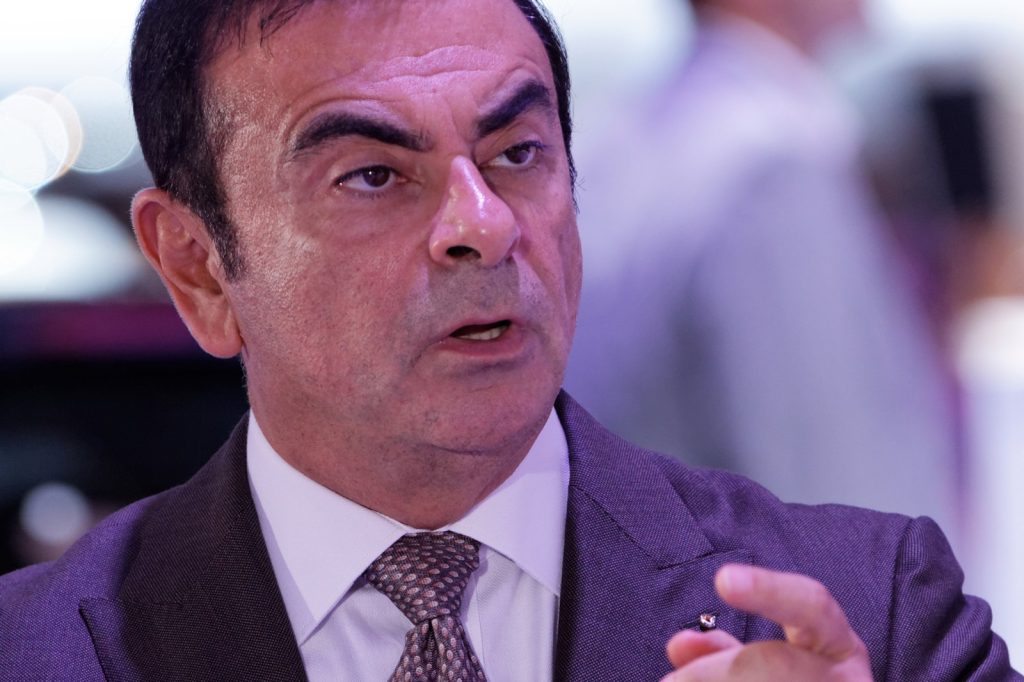
“A dying star” was how the Associated Press described Carlos Ghosn in November 2018. A week earlier he had been the chairman admired around the world. On 19 November he was arrested in Japan.
Prosecutors said Ghosn, 64, was suspected of falsifying financial reports and misusing funds at Nissan Motor Co. They alleged he had underreported his income by $44 million over five years. He was held in a detention center that also houses death row inmates. No charges had been brought, and he had made no public comment.
The fallout
Nissan’s board voted unanimously to end his 19-year reign as chairman. Mitsubishi Motors’ board fired him the same way, and its chief executive, Osamu Masuko, became interim chairman. Renault’s board kept him as CEO for the time being, pending evidence, but named a temporary replacement.
Nissan CEO Hiroto Saikawa called the suspected misconduct a betrayal. “What I feel goes far beyond remorse to outrage,” he told reporters. Japanese media had alleged, without confirmation, that Ghosn spent Nissan funds on homes in Paris, Beirut, Rio de Janeiro and Amsterdam, and on family vacations. French media suggested that friction between Renault and Nissan, and even a setup led by Saikawa, lay behind the affair. With so little disclosed, none of that was proven.
How he got there
Ghosn was born in Brazil, where his Lebanese grandfather had sought his fortune, and went back to Beirut as a child. He studied in France at the Ecole Polytechnique and the Ecole des Mines. His career began in tires. By his mid-20s he was running a Michelin factory in central France, then took charge of the company’s South American operations in Brazil and later its North American arm, based in the United States.
He moved to Renault, and in 1999 Louis Schweitzer, then Renault’s chairman, sent him to Tokyo to save Nissan. Ghosn turned around Renault and then Nissan, and linked them with Mitsubishi in an alliance that led the industry in sales.
In Japan he was admired for rescuing Nissan when it was close to bankruptcy and feared as a “cost killer.” He started by cutting thousands of jobs and closing plants in a country loath to give up lifetime employment. He also put women into management roles, livened up car design and marketing, and ended payoffs to the “sokaiya” stockholder gangsters, a move that required extra security. Britain gave him an honorary knighthood in 2006, and Lebanon issued a stamp with his likeness. He was even the star of a manga.
Money and image
The same pay that made him famous worried people. He took home a salary several times that of Toyota’s chairman, in a country of modest “salaryman” presidents, and the AP noted that his October 2016 wedding at the Grand Trianon in Versailles featured actors in 18th century dress. Some at Nissan resented the celebrity. One employee, speaking anonymously, nonetheless called him a great boss, precise, communicative and even-tempered.
Analyst Janet Lewis of Macquarie Capital Securities said the scandal would be tragic if it undermined his record of diversity and globalization. Ghosn, she said, “did things that were very hard for somebody internal to have done.”




