
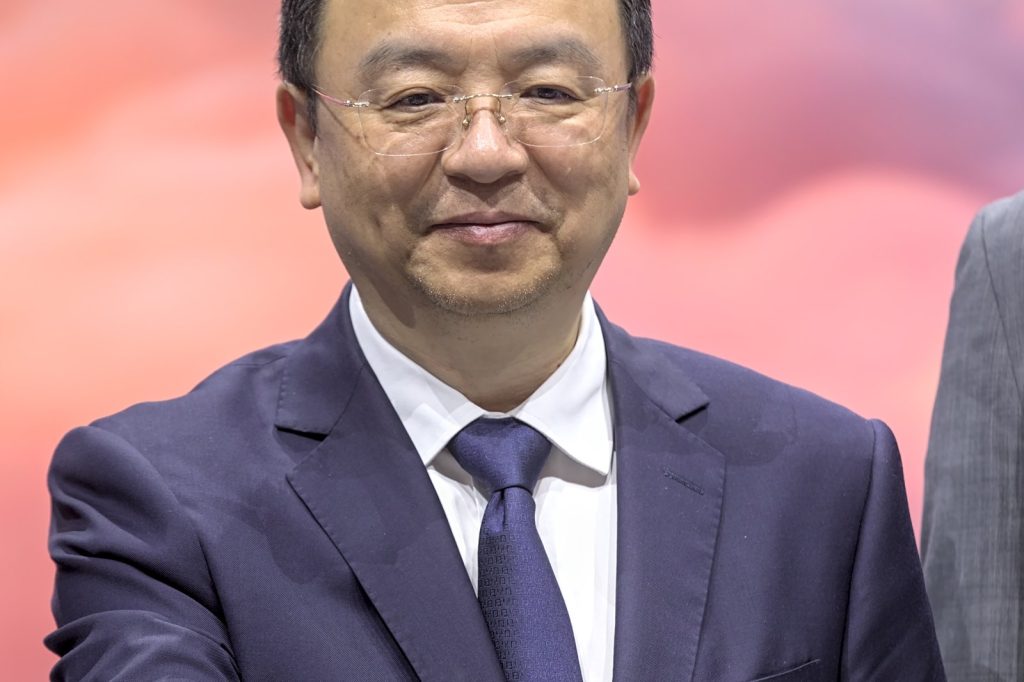
Wang Chuanfu grew up in one of China’s poorest regions, the child of rice farmers. He lost his parents young and was raised by his siblings.
A scholarship took him into chemistry and, in time, a master’s in battery technology. He started out as a scientist at a government research institute, then moved to run the business side of a state-affiliated battery company. In 1995 he left to start something of his own.
Twenty employees and no machines
With his cousin Lu Xiangyang, Wang founded Biyadi in Shenzhen, the company that became BYD. It had 20 employees and about $300,000 in capital, and no machines. It began making lithium-ion batteries for phones. The playbook was common then: copy Japanese products, trim costs and undercut rivals on price. By the early 2000s BYD supplied the biggest phone brands of the era, and Wang was one of China’s richest men.
In 2003 he bought a struggling car manufacturer. His management team was furious and shareholders threatened to pull out. Wang did not move. “I have decided that the second half of my life will be about cars,” he said, though he did not yet hold a driver’s licence.
The first BYD car was a budget sedan that looked a lot like the Toyota Corolla. It worked. Within a few years the F3 was China’s best-selling passenger car. In 2008 BYD launched a plug-in hybrid version of it, and Warren Buffett put $232 million into the company, which was already listed in Hong Kong. Buffett had been told Wang was a mix of Thomas Edison and GE’s Jack Welch.
Everything in-house
Wang is known for cutting costs, a habit that traces back to his frugal upbringing. BYD builds its own key components, chips and batteries included. Executives get five minutes to present reports to him. The company relied on low-cost labor rather than automation in its early scale-up. Despite a reported fortune of $28 billion, he is rumoured to fly economy.
The standout product is the Blade Battery, which swaps round cells for flat layers of lithium iron phosphate. It is safer and more durable, and 20 to 30 percent cheaper than lithium-ion packs containing cobalt and nickel. Toyota and Mercedes-Benz are set to use it in upcoming models.
When China made its big push into electric vehicles in 2009, its New Energy Vehicle program opened up large subsidies. In 2014 Beijing unveiled a 30-point strategy to dominate the sector, and Wang later said 20 of those points came from him.
Charging at a megawatt
BYD’s latest platform runs at 1,000 volts and can charge at 1,000 kW, nearly triple the industry peak of 350 to 400 kW on 800-volt systems. Five minutes on the charger would add enough for 400 kilometers. No station can yet deliver a full megawatt. Wang has said BYD is three to five years ahead of the global industry, a point he made over coffee with Chinese President Xi Jinping, alongside Jack Ma and other tech leaders.




