
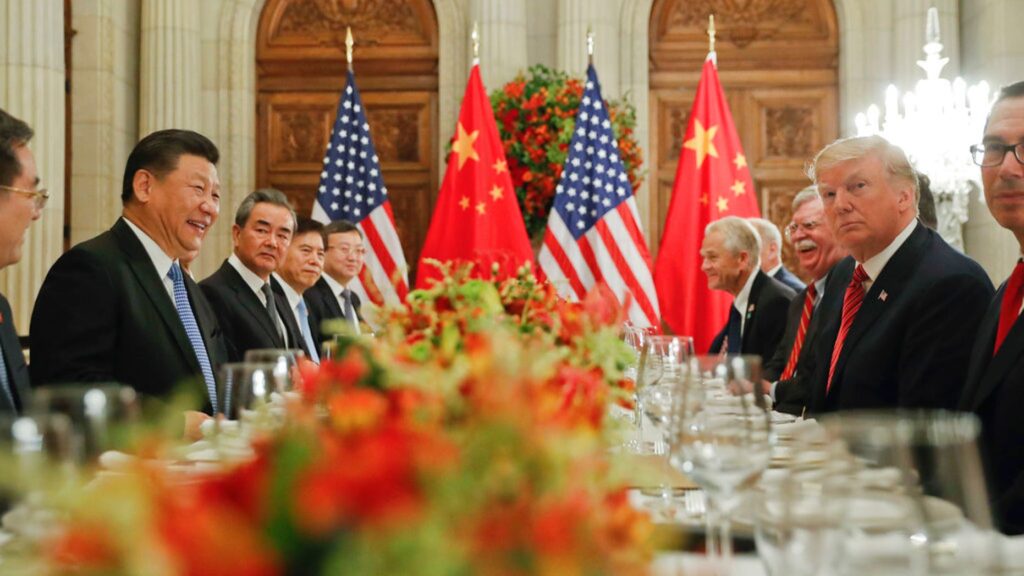
BEIJING, September 27 — China and the United States have agreed to pursue a new military crisis-communication pact, Beijing’s foreign ministry said on Saturday, following the summit between Donald Trump and Xi Jinping. The ministry said the two militaries had agreed to conclude a memorandum of understanding on “crisis communication and prevention” as soon as possible. The South China Morning Post had reported ahead of the summit that both sides would unveil measures to activate more military communication channels and bolster the existing ones.
The commitment was not included in the White House’s account of the summit, and neither the Pentagon nor US Indo-Pacific Command had publicly confirmed it as of Saturday. Beijing announced the proposed military agreement separately from eight summit deliverables covering trade, artificial intelligence, counternarcotics cooperation and international affairs.
Its statement also said the two militaries would continue working together to locate the remains of missing US service members in China. Notably, the Chinese announcement did not explain whether the proposed memorandum would create a new hotline, establish procedures for using existing connections, or define which incidents would trigger crisis consultations. That distinction could determine whether the agreement proves useful during an actual confrontation.
The two militaries already have consultation arrangements and senior communication channels. Previous periods of improved military contact have been interrupted by political disputes, while formal communication mechanisms have not always produced timely exchanges during crises.
The question US officers were already asking
The announcement offers a concrete, if still preliminary, answer to a question US military officials were considering before the Washington meeting: whether renewed senior-level engagement could produce communication channels capable of preventing an encounter at sea or in the air from escalating. “We pay very close attention to what comes out of it, who says what, and when and how,” a US Navy official told the SCMP before the summit.
The official said the conversations leading up to the meeting mattered as well, and described public dialogue between Washington and Beijing as a “confidence builder for everybody”.
Another US military official, speaking on background, said: “I believe the US’ goal is to enable both strategic stability and deterrence by denial, and I believe respectful and professional communication with China does not preclude that.” Chinese Defence Minister Dong Jun had also publicly emphasised communication before the summit, calling at the Xiangshan Forum in Beijing for an approach to security based on dialogue rather than confrontation.
Built on a recent thaw
The proposed memorandum would build on the recent resumption of senior-level contact between the armed forces. Admiral Samuel Paparo, the senior US commander in the Indo-Pacific, met General Yang Zhibin, commander of the People’s Liberation Army’s Eastern Theatre Command, during a defence conference in Victoria, British Columbia, in late August. It was their first meeting and ended a two-year interruption in theatre-level contact between the two countries.
For all the noise surrounding the summit, the salient point is narrower than the headlines suggest. What to watch next is whether Washington confirms the memorandum at all, and whether the text that eventually emerges specifies a trigger, a channel and a procedure — or merely the intention to discuss one.




