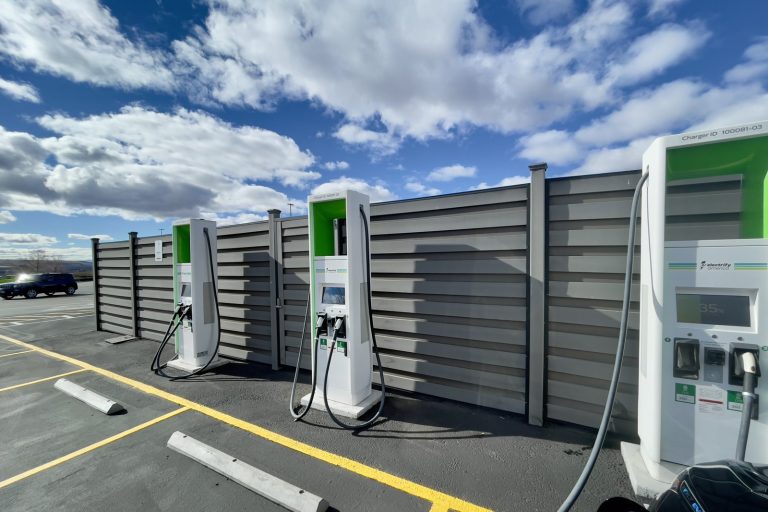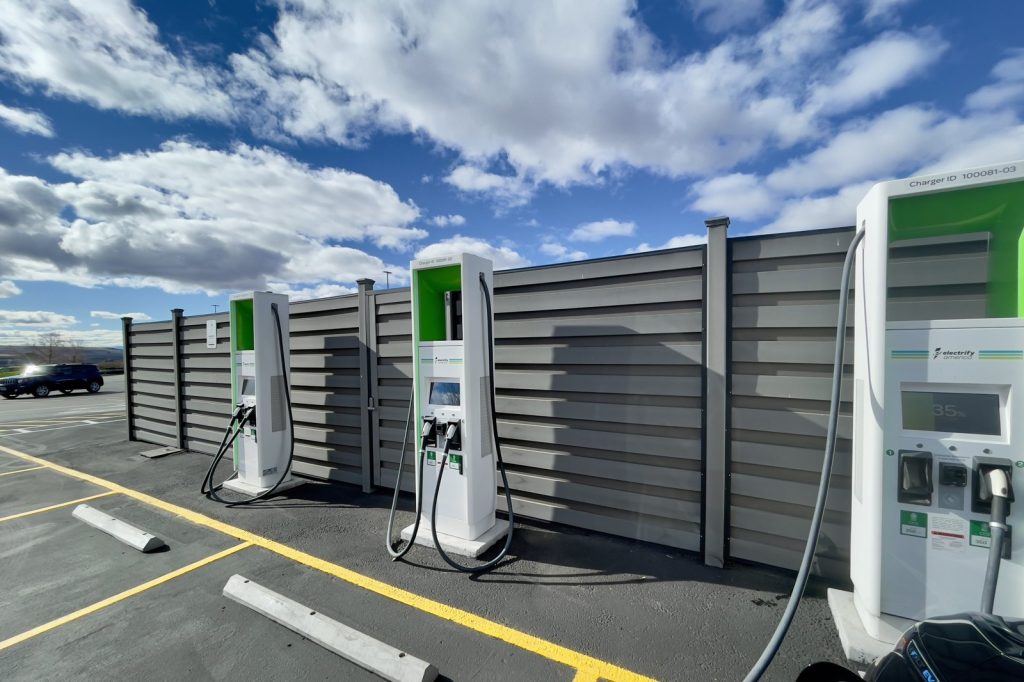
ORLANDO, October 23, 2026 — Electrify America has opened its biggest charging station yet in Orlando, featuring 24 DC fast chargers delivering up to 350 kW, as the US continues to expand its electric vehicle charging infrastructure. A charging station, also known as electric vehicle supply equipment (EVSE), supplies electrical power for recharging plug-in electric vehicles, according to Wikipedia.
Background And Definition Of Ev Charging Stations
Charging stations can be installed anywhere accessible by the electrical grid, including dedicated public charging facilities, multistorey car parks, private garages and carports, and even roadside parallel parking spots. There are two main types of EV charging stations: alternating current (AC) chargers and direct current (DC) chargers. Electric vehicle batteries can only be charged by direct current electricity, while most mains electricity from the power grid is delivered as alternating current. For this reason, most electric vehicles have a built-in AC-to-DC converter commonly known as the “onboard charger” (OBC). At an AC charging station, AC power from the grid is supplied to this onboard charger, which converts it into DC power to recharge the battery.
How Ac And Dc Chargers Work
DC chargers provide higher-power charging by integrating the converter into the charging station, thereby avoiding size, weight, and cost constraints in vehicles. The station then directly supplies DC power to the vehicle, bypassing the onboard converter. Most modern electric vehicles can accept both AC and DC power. Under the hood, the technical reality is that DC chargers are more efficient and can charge vehicles faster, making them ideal for public charging stations. As ever, the detail that matters is the type of connector used, with CCS connectors being the global standard and NACS connectors being increasingly adopted by automakers in the US, according to EV Infrastructure News.
The Numbers Behind The Us Charging Network
Public charging accounted for approximately 46% of global EV charging infrastructure revenue in 2025, driven by high capital investment in DC fast charging networks, grid upgrades, and highway corridor expansion projects, according to Wikipedia. Electrify America operates more than 350 chargers at over 60 stations in Florida, with the new Orlando station featuring 24 DC fast chargers, as reported by Electrek. The company has over 5,600 individual DC fast chargers across 1,080 charging stations in North America, including locations under its Electrify Canada brand, according to EV Infrastructure News. Florida had roughly 450,400 registered battery electric vehicles in 2025, the second-largest total in the US behind California, according to the US Department of Energy’s Alternative Fuels Data Center.
Future Growth And Regional Expansion
The expansion of EV charging infrastructure in the US is expected to continue, with Electrify America planning to open another 10-charger location in Orlando in the coming months, according to EV Infrastructure News. The company is also piloting NACS connectors at selected stations, including a separate location at the Florida Mall in Orlando, as reported by Electrek. As the US continues to transition to electric vehicles, the growth of charging infrastructure will be critical to supporting this shift. With the technical reality of EV charging being complex and nuanced, it is essential to understand the details of how charging stations work and the expansion plans of companies like Electrify America. The fact that 71% of ChargePoint’s and 74% of Blink’s sites consisted of just two ports or fewer, as noted in EV Infrastructure News, highlights the need for more extensive charging networks like Electrify America’s.
Connector Standards And Industry Developments
Internationally, charging stations must accommodate a range of connector standards to ensure vehicles from different manufacturers can use the same infrastructure. The Wikipedia entry notes that “multiple standards have been established for charging technology to enable interoperability across vendors,” and that DC fast‑charging sites are often equipped with several connector types so they can serve “vehicles that use competing standards.” This multi‑connector approach underpins the growing flexibility of public networks.
In North America, the Combined Charging System (CCS) remains the dominant global standard, while the North American Charging Standard (NACS)—originally developed by Tesla—has seen broader adoption among U.S. automakers. Electrify America’s pilot program, described by EV Infrastructure News, is testing the value of offering both CCS and NACS at selected locations, reflecting a shift toward dual‑standard stations.
Beyond connector shapes, technical standards such as UL certification and liquid‑cooled cable designs are shaping the market. Electrify America was the first U.S. charge‑point operator to deploy 350 kW chargers that meet UL standards and use liquid‑cooled cables, a milestone highlighted in the EV Infrastructure News report. Meanwhile, the European Automobile Manufacturers Association (ACEA) defined key nomenclature in 2011—distinguishing “socket outlet,” “plug,” and “cable”—providing a common language that supports global harmonisation of charging equipment.
Key Players And Their Roles
Electrify America, a US chargepoint operator, has been at the forefront of expanding the country’s electric vehicle charging infrastructure. According to EV Infrastructure News, the company has over 5,600 individual DC fast chargers across 1,080 charging stations in North America. Volkswagen established Electrify America as part of its agreement with US officials to promote EV use and mitigate the additional air pollution caused by the emissions scandal.
The US Department of Energy’s Alternative Fuels Data Center has also played a crucial role in tracking the growth of electric vehicles in the country, providing data on registered battery electric vehicles. In 2025, Florida had roughly 450,400 registered battery electric vehicles, the second-largest total in the US, behind California.
Other companies, such as ChargePoint and Blink, are also involved in the EV charging infrastructure market, although their sites tend to have fewer ports, with 71% of ChargePoint’s and 74% of Blink’s sites consisting of just two ports or fewer, as noted in EV Infrastructure News.
Sources
- Charging station
- Electrify America’s biggest charging station yet opens in theme park territory
- Electrify America opens EV charging station in Florida
Photo: Gregory Varnum (CC BY-SA 4.0)