
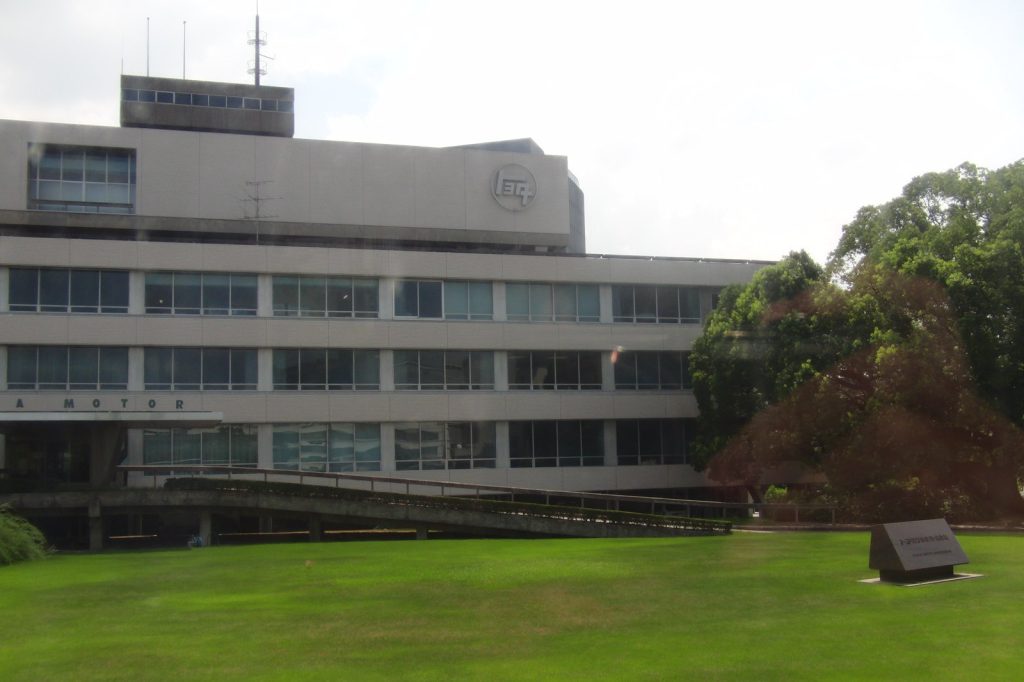
Toyota’s Higashi-Fuji Plant at the foot of Mount Fuji turned out 7.52 million vehicles in 53 years. It closed on Dec. 9, 2020. On Feb. 23, 2021, officials gathered in the old vehicle yard next to it for a groundbreaking. The plant’s site was to become Woven City.
Toyota CEO Akio Toyoda had announced the project at CES in Las Vegas in January 2020. Toyota says the pandemic slowed the world down in the year that followed, yet the project reached the start of construction without delay. Shizuoka Prefecture Governor Heita Kawakatsu and Susono City Mayor Kenji Takamura were among the guests.
A promise to the plant workers
The idea goes back to July 2018. Toyoda visited the Higashi-Fuji Plant and met the people who worked there. One of them said he wanted to help make cars in Tohoku, the region where Toyota was moving production, but that some colleagues might have to quit because they could not take their families along. What would happen to this place once the plant shut down, he asked.
Toyoda answered that he was thinking of turning the site into a connected city, a large-scale test ground for autonomous driving and more, a place that could serve the car industry for the next 50 years. At that point it was his own idea, not something the company had approved.
At the 2021 ceremony he came back to it. “We want to weave the history of Higashi-Fuji Plant into the future of this town,” he said, and added that Toyota wants to be a company the local community loves and relies on. By Toyota’s count, 7,000 people worked at the plant over the years, and about 2,000 at its peak.
What is being built
Woven City covers 175 acres, or 708,000 square metres. Toyota says it will start with about 360 residents, mainly senior citizens, families with young children and inventors, and grow to more than 2,000, Toyota employees included. Architect Bjarke Ingels of Denmark is designing it. Woven by Toyota, formerly Woven Planet, is building it. Hydrogen fuel cells will generate its electricity.
The city will have three kinds of streets that meet at ground level: one for automated driving, one for pedestrians, and one for pedestrians on personal mobility vehicles. A separate underground road will carry goods. Many buildings will be made of wood, using ancient Japanese joinery carried out by industrial robots.
The Woven City website says researchers and businesses will be able to test personal mobility, automated driving, robotics and artificial intelligence. It does not say which technologies. As of March 2024, its documents put the end of Phase 1 at the close of that year, with trials starting in 2025.
Toyota has not given a cost. MSN has reported a figure in the ballpark of AUD$15 billion, but the exact amount is not known.
Sources
- TOYOTA NEWS #120ï½Woven City Construction Kicks Off: Akioâs Promise at Groundbreaking Ceremony
- 'Mass human experiment': Inside Japan's futuristic $15 billion smart city




