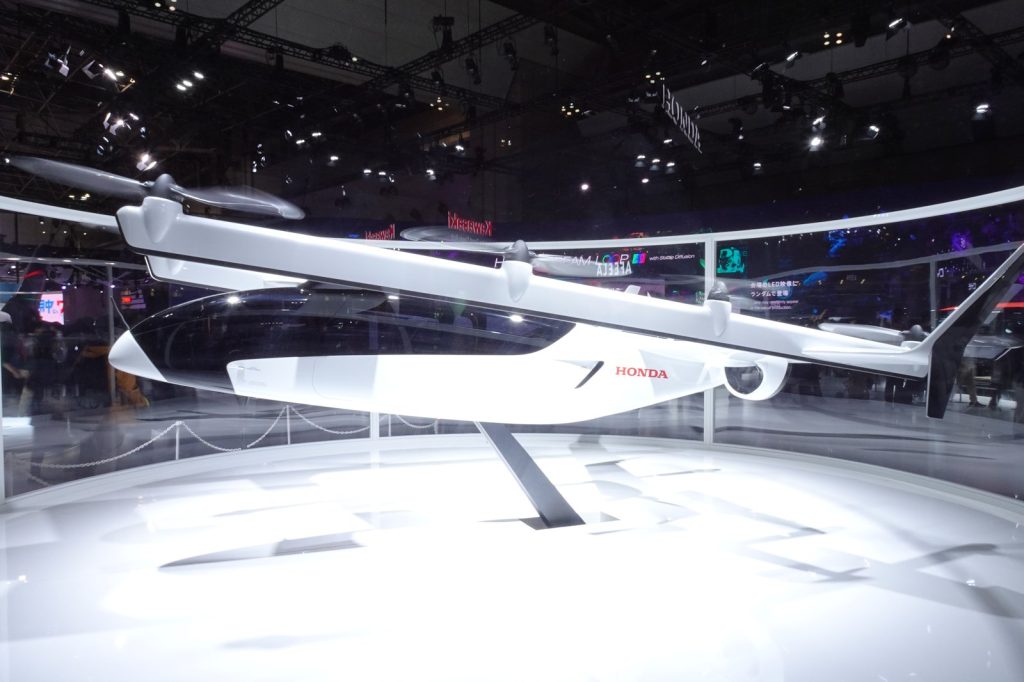
Honda wants to sell you a flight that goes 400 kilometers on a charge. The company just proved it can do that with a person on board. The Japanese automaker completed its first passenger eVTOL flight on April 1, though it waited weeks to announce it.
The aircraft has eight propellers. It is designed to be quieter than a helicopter and safer.
The range target is about 400 kilometers. That is enough to connect Tokyo to Osaka, or Los Angeles to San Francisco, without touching a runway. Honda is not a startup.
It is a company that builds millions of engines a year. That matters.
The eVTOL market is crowded with venture-backed firms that have never shipped a product. Honda has shipped everything from lawn mowers to jet planes. Its HondaJet program taught the company how to certify aircraft.
Those lessons transfer directly to this project. The stakes are concrete. Urban air mobility depends on public trust.
A crash from an unknown company could kill the entire industry. A crash from Honda would be bad, but Honda has a reputation for safety and recalls.
The company has skin in the game that a startup does not. Battery range remains the hard limit. 400 kilometers is ambitious. Current electric aircraft from competitors typically promise 100 to 250 kilometers.
If Honda can actually deliver 400 km in a production vehicle, it changes the math. A flight from a city center to a distant suburb becomes practical.
A flight between two cities becomes possible. Helicopters can do this, but they are loud, expensive, and burn jet fuel. Honda wants to replace them.
The company has not said when it will sell tickets. That silence is telling. Certification timelines for new aircraft types run years, not months.
The FAA and its Japanese counterpart will require thousands of test flights. Honda has done exactly one passenger flight.
The gap between a successful test and a commercial product is wide. It is filled with regulation, production engineering, and battery development. Automakers are racing into this space.
Toyota has invested in Joby Aviation. Hyundai has its own eVTOL division.
GM has backed a startup. Honda is going it alone. That is a gamble.
The company is betting that its in-house engineering can produce a better aircraft than a partnership can. The HondaJet proved that approach can work. The eVTOL program will prove whether it was a fluke or a formula.
The flight itself was short. The company disclosed no specifics on altitude, duration, or pilot experience.
What matters is that it happened. Honda now has real flight data. That data will drive the next iteration of the design.
The eight propellers suggest a distributed propulsion system. That architecture offers redundancy.
If one motor fails, seven remain. That is the safety edge over a helicopter. Honda’s commitment to sustainability is not rhetorical.
The company has pledged to achieve carbon neutrality by 2050. An electric aircraft fits that goal. But the grid that charges the batteries must also be clean.
Honda is not building power plants. That dependency is a risk the company has not addressed.
The eVTOL market is projected to be worth billions by 2035. That projection assumes the technology works and the public accepts it. Honda has just made that assumption a little more real.
One flight does not make a transportation revolution. But it is a flight that no other automaker has completed.
That is the fact.