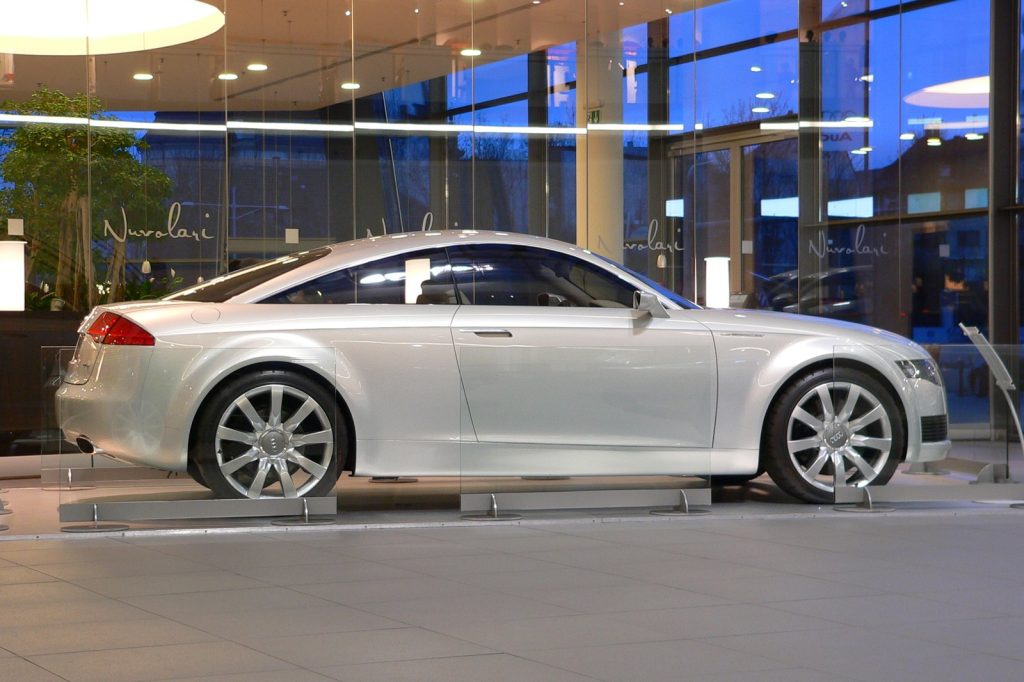
The 7.3 kWh lithium-ion battery pack inside Audi’s new Nuvolari supercar is small. In a world where electric sedans carry packs ten times that size, this one is barely enough for a short trip to the grocery store. But that is not the point.
The battery exists to feed three axial-flux electric motors, two on the front axle and one integrated with the 4.0-liter twin-turbo V8, that together push total output to 978 horsepower. That number is the story.
Ingolstadt, June 9. Audi calls the Nuvolari its fastest production vehicle ever. The numbers back it up.
Zero to sixty miles per hour arrives in 2.5 seconds. Top speed exceeds 217 miles per hour.
Those figures put the car in direct competition with the hybrid hypercars from Ferrari, Lamborghini, and McLaren. But the Nuvolari is Audi’s first hybrid supercar, and the company is betting that a combination of Formula 1-derived construction and electric assist will make it a landmark vehicle, not just a novelty. The carbon fiber monocoque is made using prepreg autoclave construction, a process borrowed directly from F1 race cars.
The braking system is brake-by-wire, meaning the pedal sends an electronic signal rather than pushing hydraulic fluid. These are racing technologies adapted for the road. They are expensive.
They are heavy on engineering. And they are exactly what a buyer paying roughly $697,000 expects.
Audi will build only 499 units. That number is not arbitrary. It is low enough to guarantee scarcity, high enough to make the project profitable.
Deliveries start in the first half of 2027. That gives the company nearly three years to refine the hybrid system and the battery management software.
It also gives collectors time to decide whether the Nuvolari is an investment or just a very fast car. The paint is called Titanium. It is the debut signature color for the model.
That detail matters in the supercar world. A signature color signifies a generation, a moment. Audi clearly intends the Nuvolari to be that kind of car.
The hybrid powertrain is the centerpiece. Two oil-cooled electric motors sit on the front axle, providing torque vectoring and all-wheel drive capability without mechanical linkages.
The third motor is integrated into the transmission housing. In E-Hybrid mode, the car can drive on electric power alone, though the 7.3 kWh pack limits that range to something more symbolic than practical. The real purpose of the electric motors is filling the torque gap at low revs, spooling the turbos, and delivering instant thrust out of corners.
That is where the 2.5-second 0-60 time comes from. The Nuvolari is not a statement about the death of the internal combustion engine.
It is a statement about making the internal combustion engine faster. The V8 is still there, still twin-turbocharged, still burning gasoline. The electric motors are there to help it, not replace it.
That is a different philosophy from the all-electric supercars being developed by some competitors. Audi is hedging. It is betting that the richest buyers still want noise, vibration, and the smell of burned fuel, just with a little electric help at the bottom end.
Whether that bet pays off depends on how the 499 cars drive. But the specifications suggest Audi has done its homework.
The axial-flux motor design is compact and power-dense. The oil cooling keeps the motors from overheating during sustained hard driving. The carbon construction keeps weight down.
The brake-by-wire system allows for precise regenerative braking integration. These are not half measures.
The Nuvolari is named for Tazio Nuvolari, the Italian racing driver who won Grands Prix for Alfa Romeo, Auto Union, and Maserati in the 1930s. He was known for winning in cars that should not have won. Audi is hoping the car that bears his name does the same.